


In the past week, a major shift shook the global automotive industry:
Ford and Renault announced a deep strategic cooperation to jointly develop low-cost EVs and light commercial vehicles, not out of opportunity but out of necessity.
The reason is simple:
they can no longer compete alone against the rapid expansion of Chinese automakers.
Ford’s CEO openly stated in an interview:
“Western automakers are in a life-or-death struggle with Chinese carmakers.”
If legacy automakers—supported by billions in capital, mature supply chains, and global factories—are feeling suffocated,
then aftermarket businesses must reconsider every part of their operating model.
1. China’s Cost-Performance Advantage Is Rewriting the Global Cost Structure
The Ford–Renault partnership is not innovation; it is survival behavior.
According to Reuters (2025-12-09 update), the alliance aims to dramatically lower vehicle costs to keep competing in Europe:
https://www.reuters.com/world/europe/ford-renault-partner-low-cost-evs-amid-chinese-competition-2025-12-09
Additional analysis from Financial Times describes the cooperation as a “defensive move forced by Chinese competition pressure”:
https://www.ft.com
Why does this matter to auto-parts importers?
Because when automakers are forced to lower costs,
everyone downstream is forced to lower costs too:
-
OE purchasing tightens
-
aftermarket pricing becomes more transparent
-
customers compare suppliers more aggressively
-
margins become thinner across the chain
If you maintain outdated assumptions about inventory, procurement, or pricing,
your business will lose competitiveness rapidly.
2. Customers No Longer Pay for Brand — They Pay for Value Density
Consumers are changing their behavior quickly.
A 2025 study by Bain & Company shows that customer loyalty is shifting toward “value-density purchasing,” where reliability, transparency, and total cost matter more than brand:
https://www.bain.com/insights
This trend directly affects auto-parts businesses:
-
customers switch suppliers more easily
-
workshops prioritize cost-effective parts
-
wholesalers push for faster, more reliable supply
-
price pressure grows faster than ever
Your customers are no longer loyal to brands.
They are loyal to whichever supplier reduces their operational risk the most.
3. You Must Reposition Yourself: You Are Not Selling Parts — You Are Selling Reliability
The real battleground is not price—it is stability and predictability.
Workshops and wholesalers care about:
-
consistent availability
-
predictable ETA
-
quality stability
-
fast problem resolution
-
transparent communication
If your supply chain is unstable,
your customers will replace you—quickly.
Reliability is your final competitive moat.
4. Actionable Strategies You Can Execute Immediately
These steps are all practical and implementable starting tomorrow.
A. Rebuild Your Product Structure (McKinsey SKU Framework)
Use the classic A/B/C segmentation model:
-
A-Class SKUs (High rotation)
-
filters, belts, ignition components
-
European SUVs and LCV fast movers
-
maintain 3–5 weeks of safety stock
-
-
B-Class SKUs (Stable rotation)
-
maintain moderate inventory
-
-
C-Class SKUs (Slow movers)
-
audit aggressively
-
shift to on-demand procurement
-
Reference: McKinsey Supply Chain Insights
https://www.mckinsey.com/capabilities/operations
B. Rewrite Your Procurement Rhythm (Avoid Freight Cost Shocks)
Recent freight data from Drewry and Freightos shows pricing rebounded in early December 2025 due to vessel rerouting and demand pressure:
https://www.drewry.co.uk
https://fbx.freightos.com
Your procurement strategy should:
-
shift 20–30 days earlier
-
adopt “small batch + high frequency”
-
use an 8-week rolling demand forecast
-
negotiate flexible delivery windows
C. Build a Delivery Transparency System
Implement:
-
weekly in-transit updates
-
early / normal / late ETA windows
-
automated WhatsApp notifications
-
proactive communication about delays
Studies show that transparency significantly increases customer retention even when delays occur.
D. Transform Your Value Communication
Stop selling price.
Start selling risk reduction:
-
how you reduce stockout
-
how you stabilize their workflow
-
how your processes improve predictability
-
how your structure reduces their procurement cost
Value communication is operational, not rhetorical.
⭐ Today’s Recommended Product
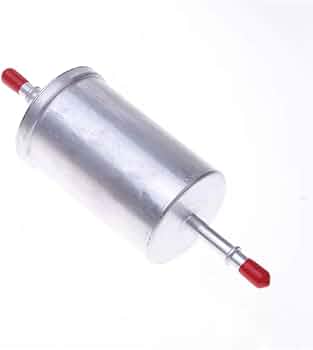
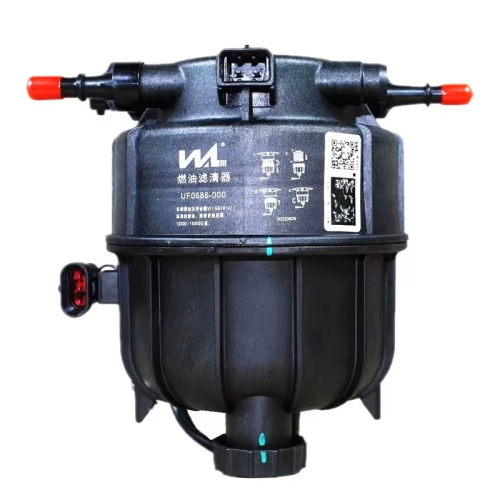
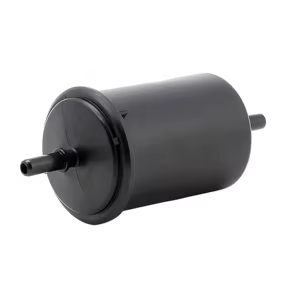
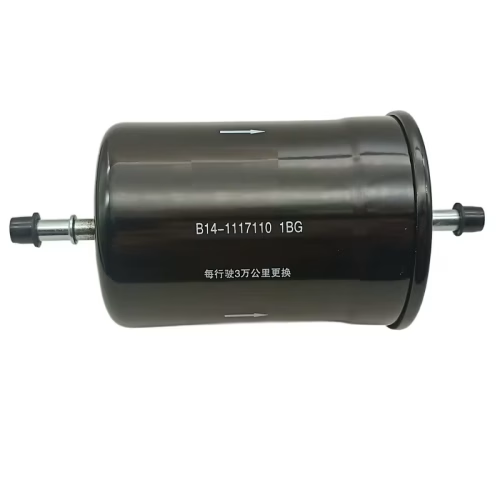
Fuel Filter 31355911 for Volvo XC90
A stable, high-precision filtration component suitable for modern European SUV platforms that demand consistent fuel-system protection.
🔗 https://bilinkglobal.com/product/fuel-filter-31355911-volvo-xc90/
Related Post