

Order Control Series — Part 4
Genuine auto parts are not interchangeable with OEM/OES, aftermarket, or remanufactured supply. Before comparing prices, importers must confirm which parts type each order line actually requires.
A customer sends an OE number, a quantity, and one instruction:
“Please quote original quality.”
The request sounds clear until the quotations arrive.
One supplier quotes a part in the vehicle brand’s packaging. Another offers a supplier-branded or neutral-packed option. A third sends two aftermarket prices without defining either grade. A fourth offers a remanufactured unit with its own warranty and core conditions.
All four quotations may refer to the same installation position. However, they do not describe the same order.
Before comparing prices, the importer must decide whether the line requires genuine brand-packaged supply, an OEM/OES option, a defined aftermarket grade, or a remanufactured unit.
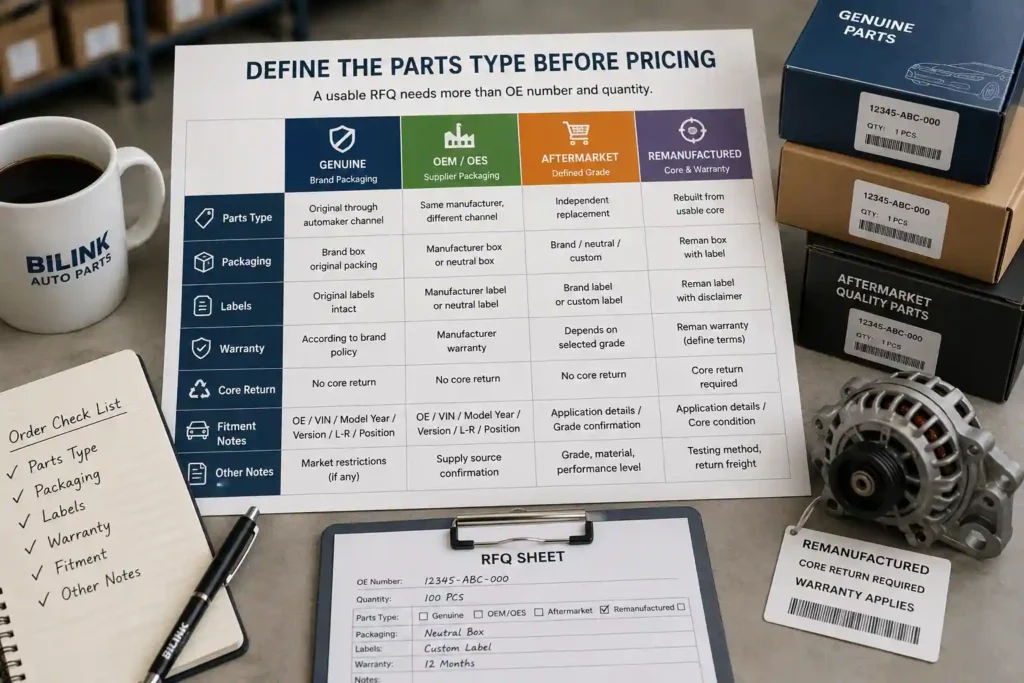
An OE number does not answer that question by itself. Neither does the VIN. Model year, market version, left-right position, connector type, hole layout, and other fitment details still matter. However, those checks cannot replace the initial parts-type decision.
Part 1 explained why a fast price still needs version confirmation. Part 2 covered how quantity changes order logic. Part 3 examined the cost boundary behind EXW and FOB prices.
Part 4 starts with a more basic question:
What type of part is the buyer actually asking for?
Genuine Auto Parts, OEM/OES, and Aftermarket Are Different Supply Types
Two quotations can show the same OE reference and still describe different products.
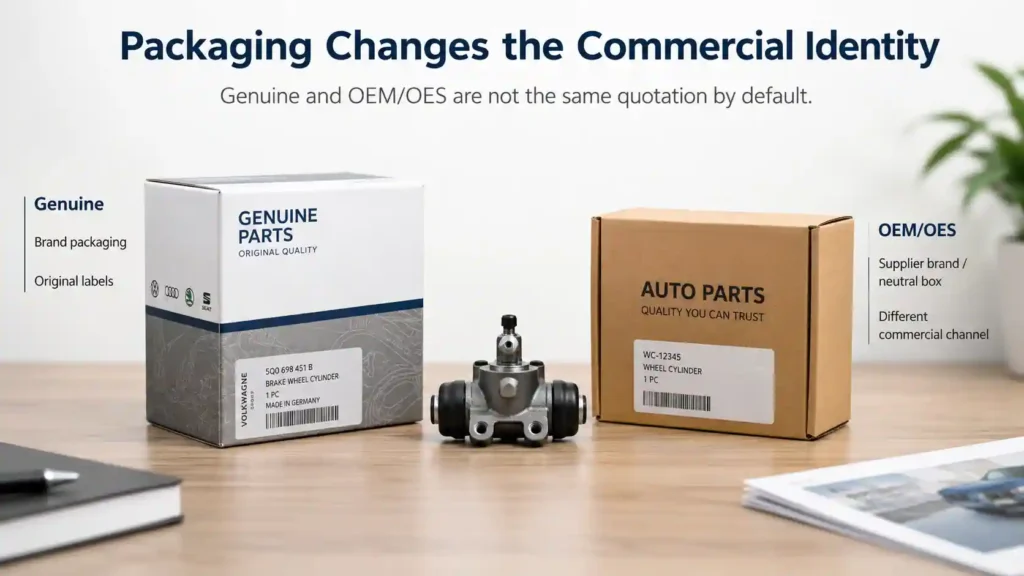
A genuine part normally enters the market through the vehicle brand’s parts channel. The vehicle-brand packaging, labels, traceability, and channel identity form part of the offer.
OEM and OES terminology is less consistent. Buyers and suppliers often use these terms to describe an original manufacturer, an original programme, supplier-branded goods, or parts associated with an OE supply system.
An aftermarket replacement comes from an independent supply route. It may target the same application, but its materials, production controls, packing, warranty, and market position can differ.
A remanufactured unit uses a recoverable core and returns it to service through inspection, component replacement, reconditioning, assembly, and testing.
These differences affect how the buyer can sell the product, which warranty applies, how stable the supply may be, and what the destination customer expects to receive.
If one supplier quotes genuine packaging and another quotes an economy aftermarket replacement, the two prices are not competing answers to the same question.
The parts type must be defined before the quotation becomes comparable.
Genuine Auto Parts Include Channel and Packaging Value
Importers usually request genuine auto parts when their customers expect vehicle-brand packaging, official labels, or a recognised distribution identity.
This may matter in dealer-related repairs, insurance work, premium retail channels, or markets where the packaging supports customer confidence.
However, genuine supply also brings practical constraints.
Availability may depend on the vehicle brand’s distribution system. Some references move quickly, while others have limited stock, long lead times, or restricted export availability. Brand packaging can also use more space than neutral export packing.
A genuine quotation should confirm whether the vehicle-brand packaging and labels remain intact. It should also identify the correct OE reference, market version, model year, installation position, and any relevant supply restriction.
Packaging alone does not confirm fitment.
A genuine headlamp may still have the wrong connector, traffic-side specification, lighting configuration, or facelift version. A genuine bumper cover still needs sensor holes, washer openings, grille interfaces, and trim details checked.
The branded box confirms the supply channel. It does not prove that the quoted version fits the buyer’s vehicle.
OEM Auto Parts and OES Supply Need a Clear Commercial Definition
Few terms create more confusion in auto parts procurement than OEM and OES.
A buyer may use “OEM” to mean original manufacturer, original specification, or simply better-than-standard aftermarket quality. A supplier may use the same word for any product connected with a company that also supplies an automaker.
That language is not precise enough for an order.
A manufacturer may supply an original vehicle programme and also produce separate aftermarket lines. Those lines may use different specifications, inspection plans, materials, packaging, or warranty conditions.
Therefore, the supplier’s relationship with an automaker does not automatically prove that the quoted item comes from the same programme or follows the same production route.
A usable OEM/OES quotation should identify the manufacturer and the offered product line. It should also explain whether the buyer will receive manufacturer-branded packaging, neutral packaging, or another commercial format.
The quotation should not imply vehicle-brand original supply when the product does not come through that brand’s parts channel.
Some distributors accept supplier-branded or neutral-packed OES products. Others require genuine brand packaging. Both requirements can be commercially valid.
They are still different orders and need separate quotations.
Aftermarket Replacement Auto Parts Need a Defined Grade
Aftermarket replacement auto parts cover a wide range of products.
The category includes economy replacements, workshop-standard parts, established aftermarket brands, premium alternatives, and export products made to an agreed specification.
Calling every option “aftermarket” does not define what the buyer will receive.
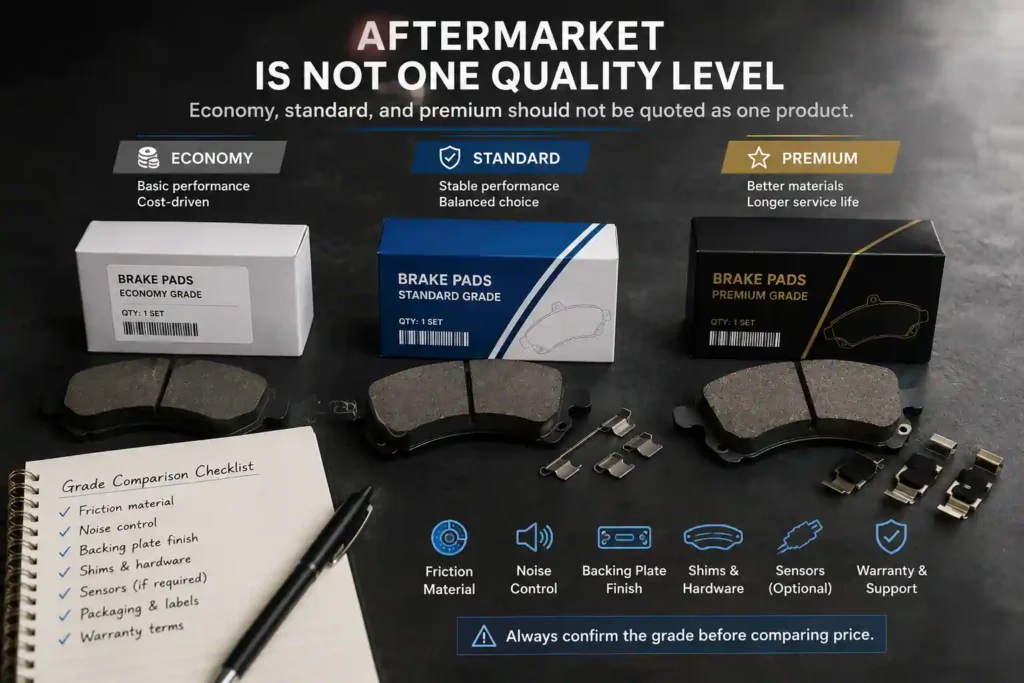
For brake pads, the grade may affect friction material, noise control, backing-plate finish, shims, sensors, and packaging. Control arms can differ in steel thickness, welding consistency, ball-joint source, bushing material, and corrosion protection.
Headlamps may differ in lens finish, sealing, reflector quality, bracket accuracy, connector type, and beam pattern. Bumper covers can vary in material, mould accuracy, flexibility, sensor-hole preparation, and surface condition.
Requests such as “good aftermarket,” “OEM quality,” “same as original,” or “cheap but good” communicate a preference. They do not create a measurable specification.
A usable request identifies the target tier, such as economy, standard, branded, or premium. An approved reference sample can also establish the expected level.
Packaging should be defined at the same time. The buyer may require neutral packing, supplier-branded cartons, or private-label packaging.
This prevents a basic replacement price from being compared with a premium aftermarket offer under the same product description.
Remanufactured Auto Parts Need Core Traceability and Warranty Terms
Remanufactured supply follows a different commercial structure from new parts.
Common categories include starters, alternators, steering racks, brake calipers, turbochargers, transmissions, and selected engine-related units.
The category can work well where new units are expensive or difficult to source and where a mature core-return system already exists.
For many newer Chinese-brand applications, however, remanufactured supply is less established than it is for long-running global vehicle platforms. Core availability, traceability, testing, and repeat supply can therefore require closer investigation.
A remanufactured quotation should state whether it includes a core charge. It should also explain whether the buyer must return an old unit, what condition the core must meet, and who bears the return freight.
Testing and warranty terms need equal clarity. The buyer should know which tests the supplier performed, how long the warranty lasts, and which installation or operating conditions can invalidate a claim.
The product must also carry accurate packaging and labels. A remanufactured unit should not enter the destination market as though it were a new part.
A remanufactured price cannot be compared directly with a new genuine or aftermarket price unless the comparison includes the core value, return cost, test coverage, appearance, and warranty.
Parts Type Does Not Replace OE, VIN, and Fitment Confirmation
Choosing genuine, OEM/OES, aftermarket, or remanufactured supply does not complete the application check.
A buyer can select the correct parts type and still receive the wrong version.
OE numbers may have supersessions or replacement references. A VIN can narrow the application, but it may not resolve every catalogue error, market conversion, or mid-cycle change.
Photos often reveal details that catalogue text misses. These can include connectors, brackets, labels, hole layouts, mounting points, and exterior differences.
Brake parts need axle, front-rear position, caliper type, and sometimes disc size. Lamps need left-right side, LHD or RHD market specification, connector type, lighting configuration, and facelift status.
Body parts require sensor holes, washer openings, trim interfaces, and finish confirmation. Chassis parts may need left-right, upper-lower, front-rear, drivetrain, and suspension-version checks.
Electronic components can require connector shape, pin count, software version, or vehicle configuration.
The supply type and the fitment definition must support the same order line.
Otherwise, the buyer may receive the requested commercial grade in the wrong physical version.
A Usable RFQ Defines the Parts Type Before Pricing
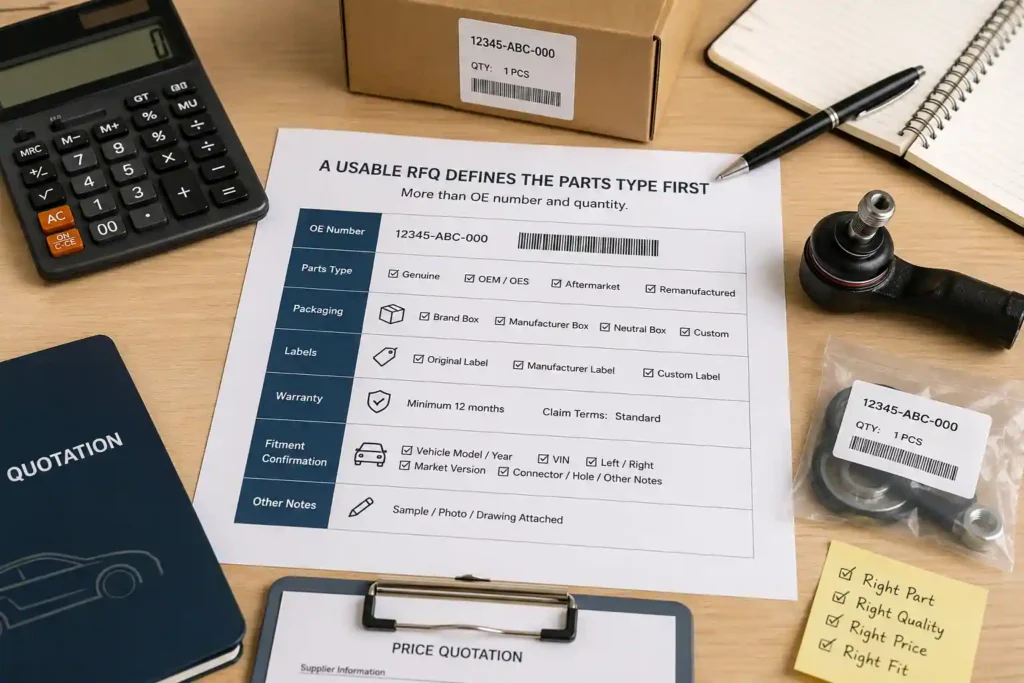
“Original quality,” “need OEM,” and “good aftermarket is acceptable” can start a discussion. They cannot finish a quotation.
A workable genuine request states that vehicle-brand packaging and labels are required. It also confirms whether the buyer will reject neutral or supplier-branded packaging.
An OEM/OES request identifies what evidence or commercial description the buyer expects. It also states whether manufacturer-branded or neutral packaging is acceptable.
For aftermarket supply, the request defines the target grade, reference sample, packaging format, label requirement, and warranty expectation. If the buyer accepts several grades, the supplier should quote them as separate options.
A remanufactured request confirms core charge, return rules, testing, appearance, label wording, and warranty. The buyer should also identify any lines where remanufactured supply is not acceptable.
These questions create some friction before pricing.
That friction costs less than paying for genuine packaging that a workshop customer does not need. It also costs less than supplying a basic aftermarket line to a distributor expecting original-channel goods.
Bilink Auto Parts View: The Quote Is Not Comparable Until the Parts Type Is Clear
At Bilink Auto Parts, an OE number and quantity form the beginning of a quotation, not the complete product definition.
We also need to know whether the line requires genuine packaging, an OEM/OES option, a defined aftermarket grade, or a remanufactured unit. Different lines within the same mixed order may reasonably use different supply types.
For example, an importer may request genuine electronic modules, supplier-branded filters, standard aftermarket chassis parts, and new steering components in one shipment. That order structure can work, provided each line keeps its commercial identity visible.
Bilink Auto Parts does not treat “OEM quality” or “same as original” as closed specifications. Those descriptions need to become clear product, packaging, label, grade, and warranty conditions before the buyer can compare quotations.
For the Chinese vehicle brands we mainly handle, remanufactured supply is not a routine option across most product categories. When a remanufactured request appears, core origin, test method, repeat availability, and warranty need separate confirmation.
The objective is not to move every line toward the most expensive option.
A standard aftermarket part may suit a workshop channel. Genuine packaging may be essential for a brand-sensitive distributor. An OEM/OES option may offer the right balance for another buyer.
Each can be the correct choice.
They should not appear under one product description as though they were interchangeable.
Until the parts type is defined, the quotation is not necessarily wrong. It is simply not finished.
Order Control Series · Bilink Auto Parts
This article is part of the Bilink Auto Parts Order Control Series for importers, wholesalers, and distributors managing mixed auto parts orders.
Part 1: Car Parts Quotation: Why a Fast Price Still Needs Version Confirmation
A fast price is useful only when it belongs to the correct version.
Part 2: Auto Parts Order Quantity: How It Changes Price, Freight, and Lead Time
Quantity becomes useful when it matches sourcing, packing, freight, lead-time, and version-control logic.
Part 3: Auto Parts Price Comparison: Why EXW and FOB Prices Do Not Show the Full Cost
A price becomes comparable only when the quotation’s cost boundary is clear.
Part 4: Genuine Auto Parts vs OEM/OES, Aftermarket, and Remanufactured Parts: What Importers Must Confirm
A quotation becomes comparable only after the buyer defines the required supply type.