

Order Control Series — Part 2
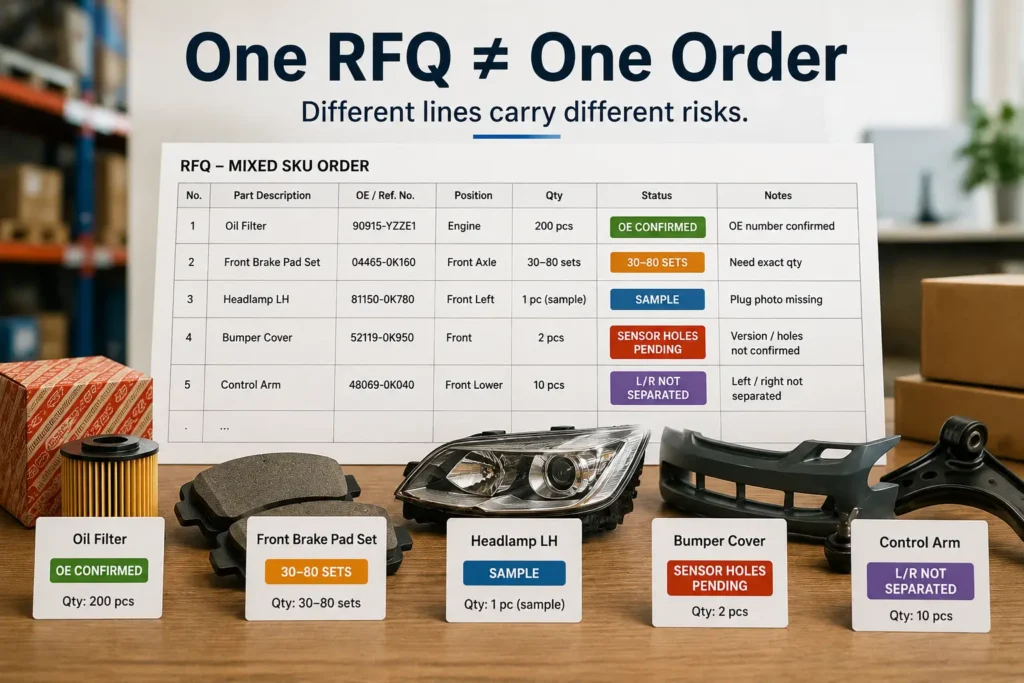
An auto parts order quantity problem often starts inside a mixed SKU order with dozens of lines. A buyer sends a mixed SKU order with 46 lines.
Oil filters have OE numbers and 200 pcs confirmed. The buyer marks front brake pads as “30–80 sets.” The sheet lists one left headlamp for a right-hand-drive market as a sample, but it does not include the plug photo. Two bumper covers carry the note “2019–2021,” yet no one has confirmed the sensor holes or facelift version. The sheet also includes control arms, but it does not separate left and right sides.
The buyer asks for one updated price.
But this is not one order yet. It is a spreadsheet holding several different order risks.
In the previous article, we explained why a fast price still needs version confirmation. Quantity adds another layer. When the number grows, an unclear version does not become safer. It becomes more expensive.
Auto parts order quantity is not just about how many pieces you want to buy. It decides how much price risk, freight risk, version risk, packing risk, and stock risk you accept before the goods leave China.
Part 3 explains why EXW and FOB prices do not show the full cost of the same mixed auto parts order. Part 4 then explains why genuine, OEM/OES, aftermarket, and remanufactured supply types must be defined before their prices can be compared.
Auto parts order quantity is not just about how many pieces you want to buy. It decides how much price risk, freight risk, version risk, packing risk, and stock risk you already accept before the goods leave China.
Auto Parts Order Quantity Changes the Order Before the Price Changes
Most importers know that a larger quantity can reduce the unit price. In real aftermarket parts sourcing, however, quantity changes the order structure before it changes any number on the quotation sheet.
Ten pieces may come from warehouse stock. Two hundred pieces may need factory supply. Five hundred pieces may change packaging, labelling, carton planning, and lead time.
A filter, a brake pad, a bumper, a headlamp, and a control arm do not respond to quantity in the same way. Filters may move quickly because stock is available. Brake pads need axle position and carton quantity checks. A bumper may need stronger packing before freight can be judged. A headlamp needs plug and market-version confirmation before any bulk number is useful.
So the real question is not only:
“How many pieces?”
The better question is:
“What does this quantity commit the order to?”
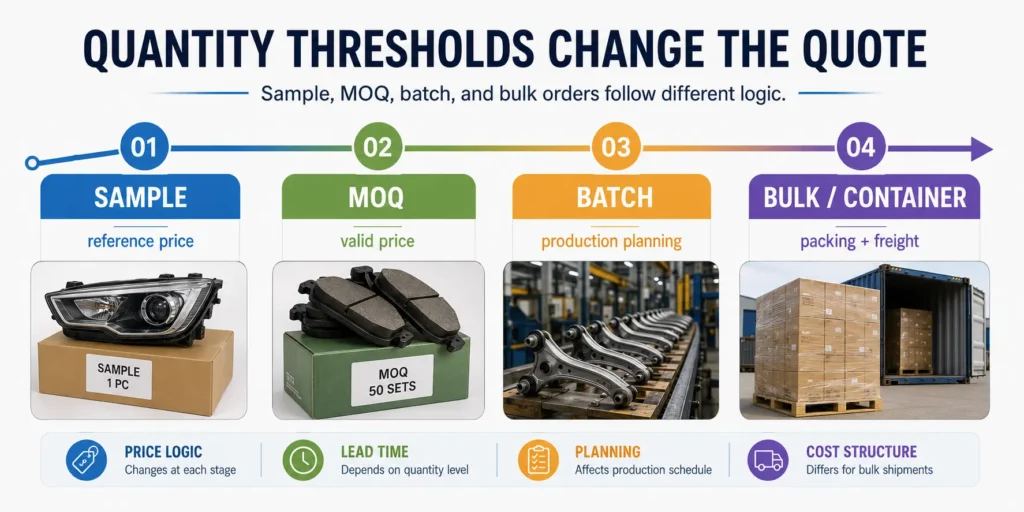
A small quantity may create a sample quote. A medium quantity may trigger auto parts MOQ logic. A larger quantity may enter batch production. A container-level quantity may change the freight method entirely.
This is why auto parts pricing by quantity cannot be judged from the unit price column alone. The same part can sit in different commercial logic when the quantity changes.
A Mixed SKU Order Is Not One Order Until Quantities Are Separated
A mixed SKU order often looks like one order because it sits in one Excel file.
Operationally, it may contain several different order states.
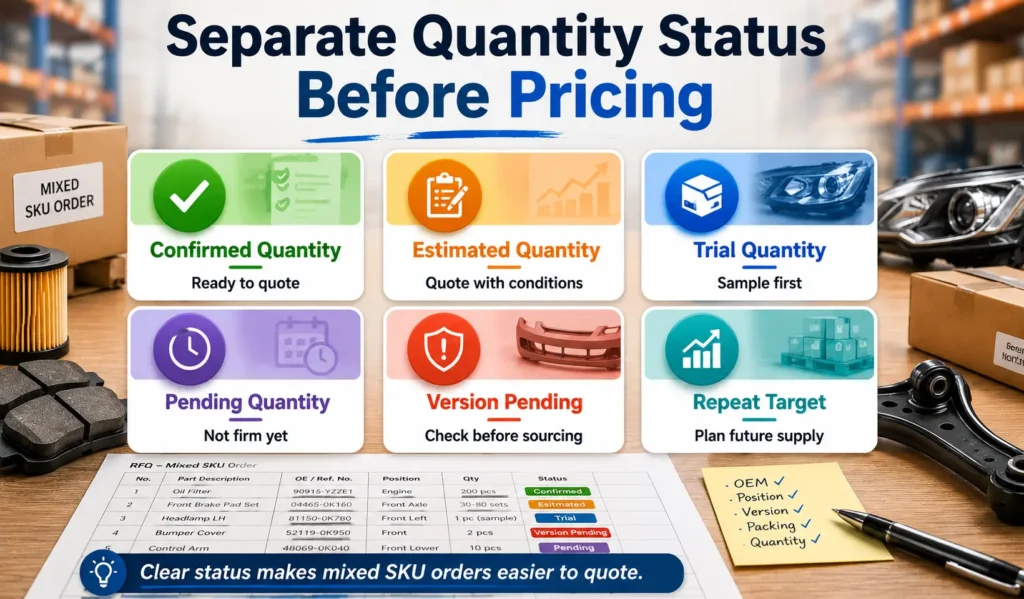
Some lines can move. Others still carry estimated quantities. A few belong to trial checks. Some need OE confirmation. Others still need left-right position, front-rear position, year range, plug type, or bumper hole layout before sourcing can start.
Treating all lines as equal creates false speed.
A better RFQ separates quantity status before price comparison begins.
Quantity Status Cards for a Cleaner RFQ
Confirmed Quantity
OE number, position, and quantity are clear.
Example: oil filter, 200 pcs confirmed.
Order meaning: ready for price checking.
Estimated Quantity
The buyer gives a range, not a fixed number.
Example: front brake pads, 30–80 sets.
Order meaning: quote may need conditions.
Trial Quantity
The order starts with a sample or first test.
Example: RHD left headlamp, 1 pc sample.
Order meaning: version check before repeat order.
Pending Quantity
The product may be needed, but quantity is open.
Example: rear shock absorber, quantity not confirmed.
Order meaning: not ready for firm quotation.
Version-Pending Quantity
Quantity is planned, but the version is not closed.
Example: bumper cover, 2 pcs planned, sensor holes unclear.
Order meaning: version and packing must be checked first.
Repeat Order Target
The buyer shows expected future quantity.
Example: same OE brake pads, 200 sets within 60 days.
Order meaning: useful for stock or batch planning.
Why Quantity Status Matters Before Price Comparison
This structure matters because quantity without status misleads both sides.
For example, 200 oil filters with confirmed OE can move quickly. Fifty front brake pad sets can move if axle position and OE are clear. But one headlamp sample without plug confirmation should not be priced as if repeat supply is already safe. Two bumper covers with uncertain sensor holes should not enter freight or packing logic as confirmed items.
A usable auto parts order quantity is not just a number. It is a number with status.
Quantity Thresholds Change Auto Parts MOQ, Price, and Lead Time
Quantity thresholds change the conversation.
Below MOQ, the supplier may decline the line, quote sample price, or add a small-order charge. At MOQ level, the price may be valid, but the line may need to wait for production planning. Above MOQ, the price can become more stable, yet packing and labelling requirements may become more serious.
Many importers misunderstand auto parts MOQ here.
MOQ is not only a factory rule. It often reflects production setup, carton planning, material preparation, and stock turnover. A supplier may accept five pieces from stock, but not from production. Another supplier may quote 50 pieces only when that part can join a normal batch.
Lead time also changes near quantity thresholds.
An order of 45 pieces for a part with a 50-piece production minimum may wait for another order to complete the batch. An order of 55 pieces may trigger production, but the factory may not start until material or mould scheduling is confirmed.
The difference looks small on the RFQ sheet.
Inside the supply chain, it can change the whole path.
Slow-moving items make this more visible. Lamps, bumpers, grilles, mirrors, radiators, and some chassis parts may not always sit in stock. If the quantity pushes the order into production, spare parts lead time becomes a production question, not a warehouse question.
In most cases, the supplier did not change the answer — the quantity changed the order path, and the lead time followed.
Freight, Packing, and Labelling Change When Quantity Crosses a Threshold
Freight mode is not only a logistics decision.
It is often a quantity decision.
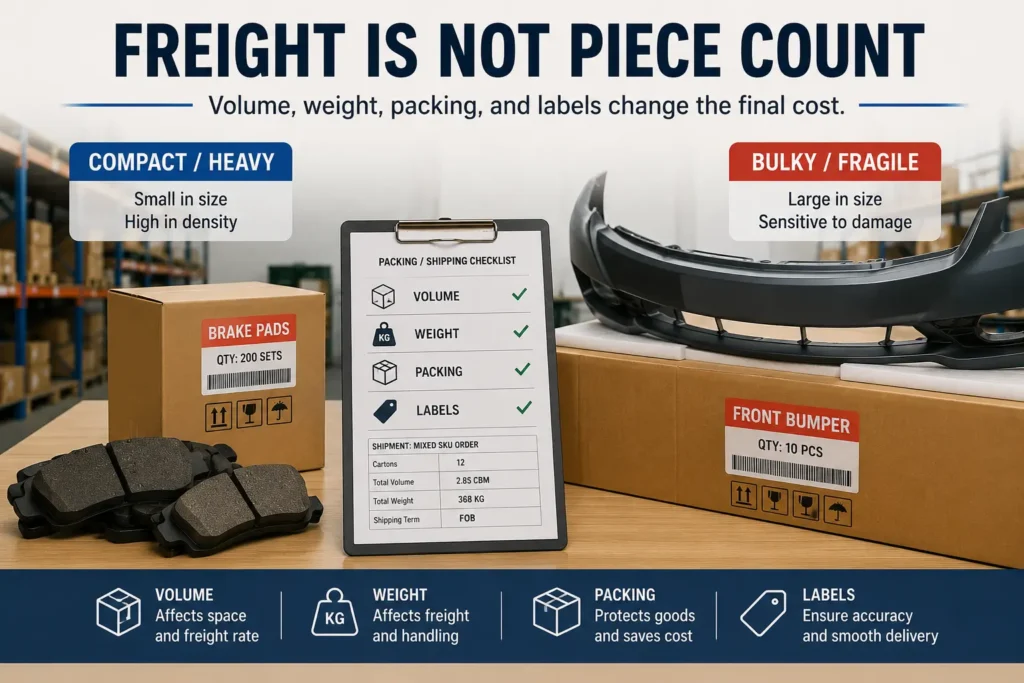
A small quantity of high-value sensors, switches, or lamps may work by courier or air freight. The same method may fail for bumpers, radiators, grilles, or multiple body panels because volume becomes the main cost driver.
A carton of 200 brake pads and a pallet of 20 bumper covers do not behave the same way. One is compact and heavy. The other may be large, fragile, and difficult to stack.
When both appear in one shipment, import auto parts freight cannot be judged by piece count.
Trade terms also change how the cost is read. EXW, FOB, and CIF are not just price labels. They decide which costs sit inside the quote and which costs remain outside it. Therefore, freight logic should be checked before the buyer treats the unit price as final.
Packing and Labelling Follow the Quantity Decision
Packing changes with quantity as well.
A single sample headlamp may need protection, but it may not need retail labels. A repeat order of 100 lamps may need part-number labels, carton marks, side-position labels, and separation by market version. A few bumper covers may ship in reinforced cartons. A larger quantity may need wooden frame support, pallet planning, or separate loading instructions.
Mixed orders add another layer.
Filters can be packed tightly. Brake parts need weight control. Lamps need protection. Body parts need space. Chassis parts may need side labels. If these items enter packing without quantity and status separation, the carton plan becomes easy to damage.
For aftermarket parts wholesale, labelling is not decoration. The importer may sell to distributors, workshops, branch warehouses, or retail counters. When the label is unclear, the problem moves from China to the destination warehouse.
Quantity cannot be separated from packing.
Once the order grows, the buyer no longer needs only a unit price. The order needs a packing and labelling plan that matches resale, storage, and distribution.
Higher Auto Parts Order Quantity Makes Version Risk Bigger, Not Smaller
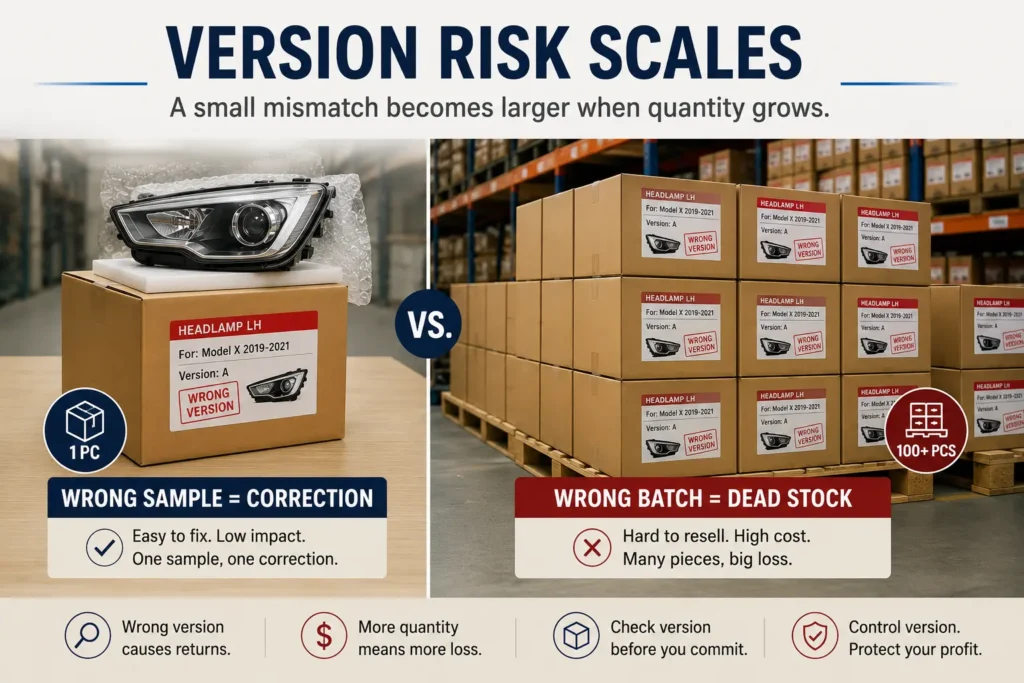
A larger quantity does not reduce version risk. It scales the risk across more stock, more cartons, and more customer-facing pressure.
A wrong headlamp sample is a correction; a wrong headlamp batch becomes dead stock. Two wrong bumper covers may create one claim; fifty wrong bumper covers can become a warehouse problem.
A fast price still needs version confirmation. When auto parts order quantity grows, that confirmation becomes more important, not less important.
For lamps, quantity should not be confirmed before plug type, lighting type, left-hand or right-hand traffic version, and market version are clear. A right-hand-drive headlamp and a left-hand-drive headlamp may look close in a product list, but they cannot move under the same quantity line.
Bumper cover quantity carries a different risk. The issue often sits in sensor holes, fog lamp openings, washer holes, facelift changes, grille fitment, or market trim. A two-piece sample order may still be manageable. A bulk order with the wrong hole layout can block resale.
Chassis parts need side and position separation before quantity confirmation. Control arms, tie rods, shock absorbers, and stabilizer links may have side or position differences. A quantity of 100 pcs means little if the sheet does not show how many are left, right, front, rear, upper, or lower.
Year-sensitive parts create a quieter problem. A model can have a mid-cycle change. Old and new versions may look close in warehouse photos, yet fail during installation.
So quantity and version confirmation must move together.
A high quantity with unclear version status does not make the order more serious. It only makes the possible mistake more expensive.
Weak Quantity Signals vs Strong Quantity Signals
Weak quantity signals do not always mean the buyer is unserious. They mean the supplier cannot build a stable order around the request yet.
Clear Quantity Status Moves the Right Lines Forward
Asking for a quote before confirming quantity keeps every line in reference-quote status. It may help early discussion, but it does not support firm sourcing. By contrast, separating confirmed, estimated, and pending quantities upfront lets the supplier move ready items first while uncertain lines remain visible.
Version Control Must Come Before Quantity Commitment
Writing “100 pcs” before the team closes OE, side, plug type, year range, or market version creates a larger possible mistake. A stronger RFQ adds quantity only after OE, market version, and installation position are clear. That makes the number useful for sourcing, not just pricing.
Freight and Packing Need Quantity Context
Requesting EXW, FOB, and CIF before checking volume, packing, and SKU mix can make a quote look complete while the freight logic remains open. A stronger request reviews quantity, volume, packing, and shipment method together, especially when a car parts bulk order includes bulky and fragile parts in the same shipment.
The difference is not paperwork. It is the difference between surface movement and real order control. A few questions before quotation may prevent a wrong version, a wrong label, a freight surprise, or a packing delay after the order is already moving.
Bilink Auto Parts View: Auto Parts Order Quantity Without Version Confirmation Is Not Ready
At Bilink Auto Parts, we do not treat quantity and version status as separate issues.
Only when the version behind the quantity is clear can that line become ready for sourcing.
At Bilink Auto Parts, confirmed lines with clear OE, position, version, and packing basis move to sourcing without delay. Lines that are estimated, pending, or version-unclear carry a status note, because treating them as confirmed does not speed the order up. It only moves the risk forward into packing, freight, or after-sales handling.
This matters most for lamps, bumpers, mirrors, and left-right chassis components. In these categories, a small error does not stay small when the quantity grows. It can become unusable stock, repacking work, local customer pressure, or replacement shipment cost.
Freight and repeat orders still need quantity control
Freight and lead time also need to be judged by the full consignment, not by one line at a time. An order may look simple line by line. Yet once volume, weight, packing, and SKU separation are calculated together, the result can change.
For repeat buyers, quantity history can also support version control. If the same market has received the same confirmed version across several orders, that history can reduce catalog uncertainty when a new batch is sourced. It also lowers the chance of version drift.
For importers, speed should not mean pushing every line forward at once. It should mean knowing which lines are ready, which lines need conditions, and which lines must stay out of sourcing until the version, packing, and auto parts order quantity logic are closed.
A quantity without product definition is not a ready order. It is an assumption waiting to surface during sourcing, packing, freight calculation, or after-sales handling.
If you are putting together a mixed order and want a second check on quantity status and version before it goes to sourcing, that is exactly the kind of review we do before quoting.
Order Control Series
This article is part of Bilink Auto Parts’ Order Control Series for importers, wholesalers, and distributors managing mixed auto parts orders.
Part 1: Car Parts Quotation: Why a Fast Price Still Needs Version Confirmation
A fast price is useful only when the quoted price belongs to the correct version.
Part 2: Auto Parts Order Quantity: How It Changes Price, Freight, and Lead Time
Quantity is useful only when it matches the sourcing, packing, freight, and version-control logic behind the order.
Part 3: Auto Parts Price Comparison: Why EXW, FOB, and Full Cost Give Different Answers
A lower unit price does not always mean a lower landed cost when freight, packing, consolidation, and order-control risks included.
Part 4: Genuine Auto Parts vs OEM/OES, Aftermarket, and Remanufactured Parts: What Importers Must Confirm
A quotation becomes comparable only after the buyer defines the required supply type.
When you are ready to request a quotation, send the reference and quantity for each item, together with the destination and packing requirements, so the order conditions can be reviewed together.