

A fast car parts quotation can make an order feel under control.
You send a vehicle model and a part name. The supplier replies on the same day. The price looks acceptable, so the order moves into sourcing, packing, and shipment.
The problem often appears later.
A lamp plug does not match. A bumper has the wrong sensor holes. A brake pad shape does not fit the caliper. A left-side part should have been right-side. By then, the issue is no longer just a wrong car parts quotation. It has become a claim, a delay, a replacement cost, and a stock problem.
This is why a fast quotation needs more than speed.
It needs version confirmation.
A useful quotation should not only answer “how much.” It should also answer a more important question:
Which version is this price for?
As a global supplier of China-made auto parts, Bilink Auto Parts often sees this issue in mixed-SKU import orders. A price may look complete on paper. However, without version confirmation, the order can still carry the wrong item into the next step.
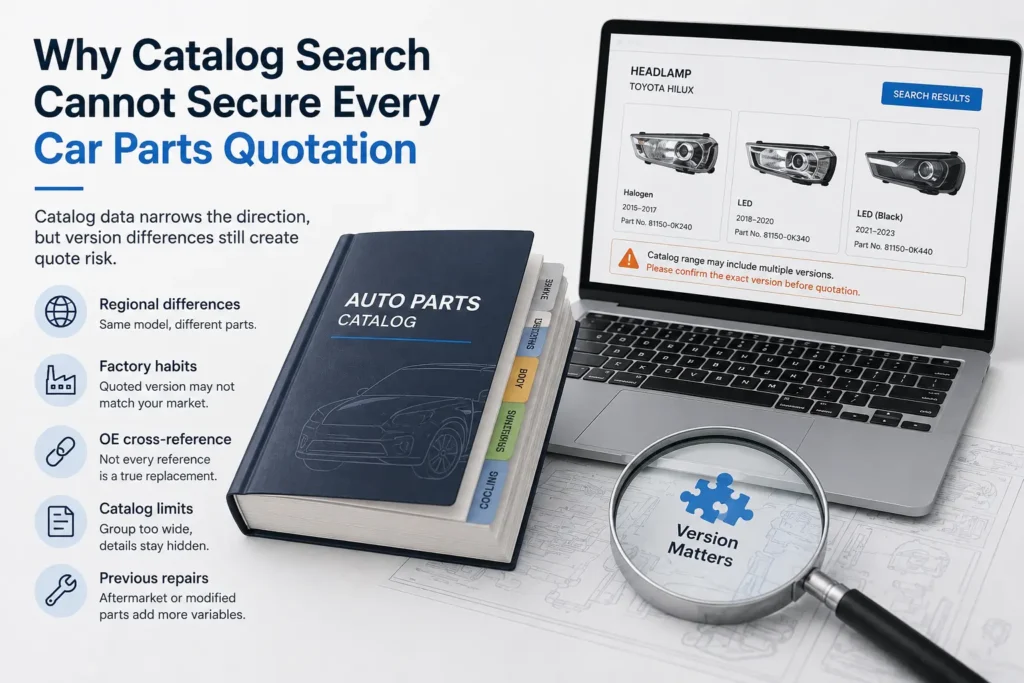
Why a Fast Car Parts Quotation Can Still Become a Wrong Order
A car parts quotation can look correct and still carry the wrong version.
The sheet may include the model, product name, quantity, unit price, lead time, and trade term. Nothing looks missing at first glance. The hidden problem sits behind the part description.
“Toyota Hilux headlamp” is not always one fixed item. The lamp may differ by halogen or LED version, plug type, lens layout, daytime running light design, or driving-side requirement.
“Haval H6 brake pads” can look clear as well. Yet front and rear pads are different. Some versions may use different caliper systems. A price without axle position is not a complete comparison.
“GWM Poer front bumper” can create the same problem. One version may have parking sensor holes. Another may not. Fog lamp openings, grille style, trim design, and market version can all change the part.
False speed starts when the price comes back quickly, but the product boundary stays loose.
The order looks active. In practice, the risk has only moved into sourcing, packing, or shipment.
For importers, a slow reply is not the only problem. A fast price attached to an undefined version can be worse.
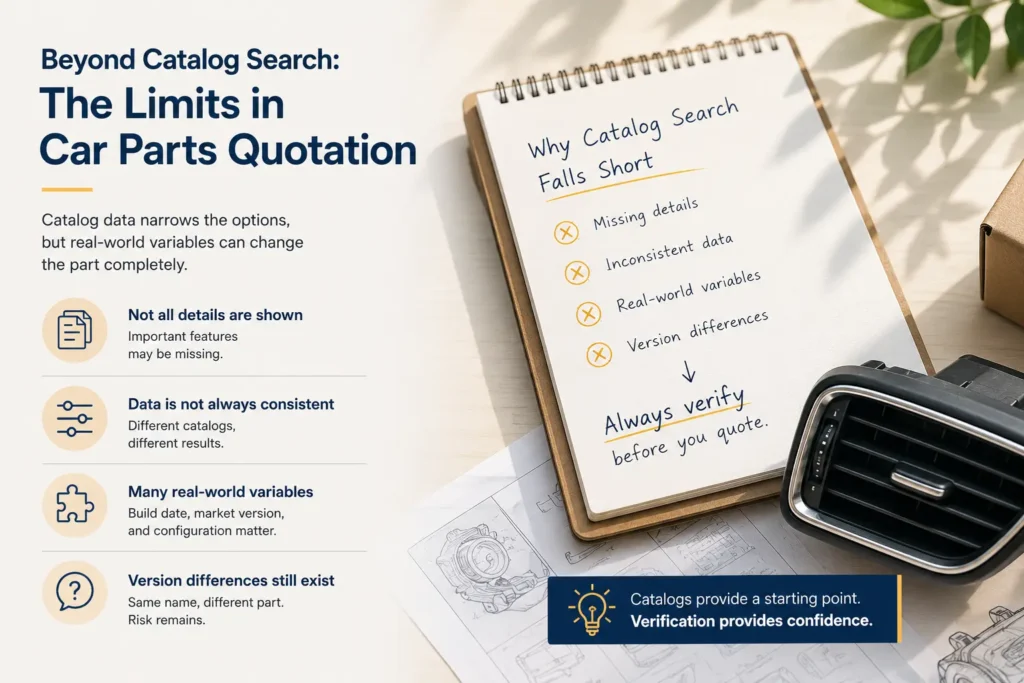
Why Catalog Search Cannot Remove Every Auto Parts Quote Risk
Catalog search can narrow the direction. However, it cannot remove every risk.
Regional data may describe the same model differently. A vehicle sold in South Africa, the Middle East, Southeast Asia, Latin America, or China may share a model name but use different parts.
Factory quotation habits add another layer. A factory often quotes the version it produces most often. That may be practical for production, but it may not match your local vehicle population.
OE numbers can also sit inside replacement chains. Some references are true replacements. Others only look close. As a result, a cross-reference list can support checking, but it should not replace version judgment.
Aftermarket catalogs may group similar parts too broadly. Two items can share an application range while still differing in plug, bracket, hole position, side, or trim detail.
Previous repairs make the situation less clean. A vehicle may already carry an aftermarket replacement, local repair part, or modified component. Therefore, a catalog cannot always show what is currently installed.
A serious auto parts quote request should not rely on catalog search alone.
The catalog points the search in the right direction. Version confirmation decides whether the quotation is safe enough to use.
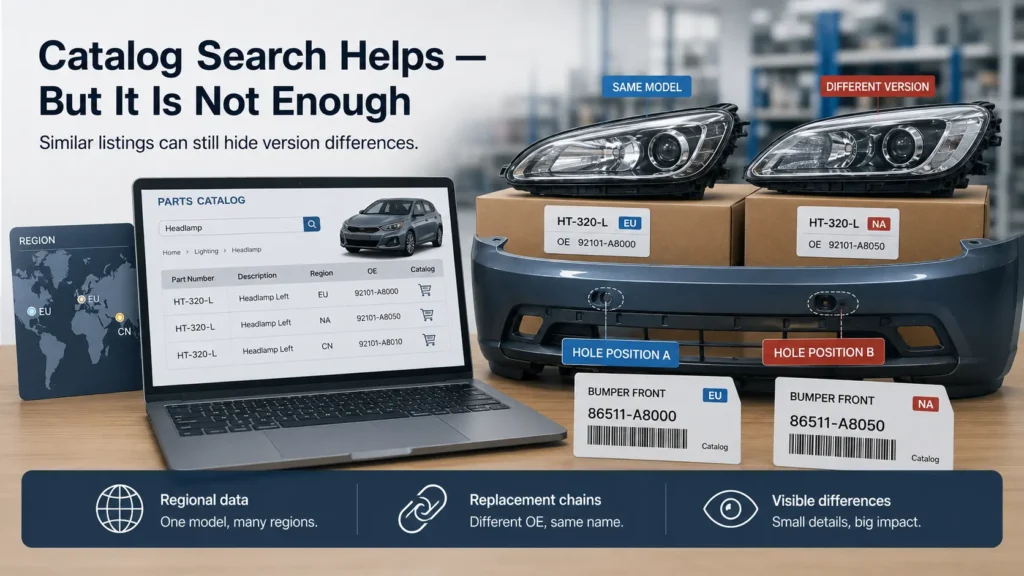
Version Confirmation: The Missing Step Behind Many Auto Parts Quotes
Version confirmation checks the details that can change the physical part. It does not mean asking for more information without purpose. Instead, it makes the price belong to a specific item, not a broad product name.
Some parts change mainly because of position and system design. Brake pads may differ by front or rear axle, caliper type, disc size, and vehicle version. Similarly, control arms, shock absorbers, and other suspension parts can change by side, position, drive type, or platform version. In these cases, a short part name may look clear, but the actual item still depends on installation context.
Other parts depend more on visible version details. A headlamp may share the same general shape, yet the plug, lighting type, lens layout, traffic-side requirement, or market version can change the final part. Body parts create the same problem in another form. A bumper, grille, fender, mirror, or tailgate may change by facelift version, sensor holes, fog lamp openings, brackets, trim lines, or surface design. Therefore, photos often confirm what the part name cannot show.
Cooling parts and service parts sit between these two groups. A radiator, hose, water pump, filter, or belt may move faster than a bumper or lamp. Still, engine code, production year, layout, and OE cross-reference can affect the result. As a result, a good auto parts quote should make these boundaries visible before the buyer starts comparing prices.
Without that boundary, the buyer may only compare numbers, not confirmed parts.
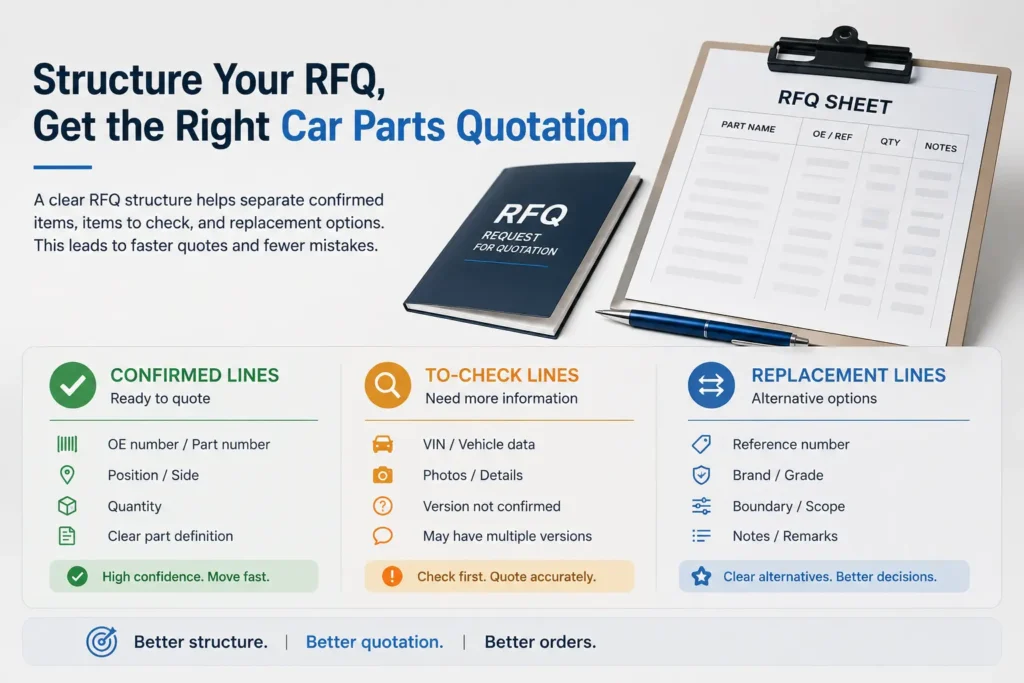
Confirmed, To-Check, and Replacement Lines: A Better RFQ Structure
A normal RFQ sheet lists parts.
A better RFQ sheet shows order status.
This difference matters in mixed import auto parts orders. Filters, brake parts, shock absorbers, control arms, lamps, cooling parts, body parts, switches, sensors, and clips may appear in one file. If every line looks equally ready, the supplier may quote too broadly. The buyer may then compare prices built on different assumptions.
A cleaner RFQ separates the list into three groups.
Confirmed Lines
Confirmed lines have enough information for quotation.
They usually include OE number, part name, position, quantity, and vehicle information. When the part has left, right, front, rear, upper, or lower versions, that detail should already be clear.
A confirmed oil filter with OE number and quantity can move quickly. A brake pad with correct axle position and quantity can also move into price checking without extra guessing.
These lines should move fast.
To-Check Lines
To-check lines still need version confirmation.
They may only include model and part name. They may lack photos. Some need VIN checking. Others involve lamps, body parts, electrical items, or suspension parts with several possible versions.
A headlamp without plug photos should carry a status note. A bumper with unclear sensor holes should not be treated as final. A control arm with left-right uncertainty needs correction before price comparison.
These lines need a status note before a final price.
A guess may look faster. However, it can create a wrong purchase.
Replacement Lines
Replacement lines may accept aftermarket supply, economy grade, or cross-reference options.
They need clear boundaries.
If OEM-level quality is required, the quotation should say so. If aftermarket replacement is acceptable, the grade, reference basis, and version match should stay visible.
This structure changes how the order runs.
Ready items move forward. Unclear items receive the right checks. Replacement items do not get mixed with confirmed items. For that reason, order efficiency comes from moving clear lines quickly while stopping uncertain lines before they damage the shipment.

Bilink Auto Parts View: We Confirm the Version Behind the Price
Most suppliers can send a price.
The harder work is confirming what the price covers.
At Bilink Auto Parts, we separate ready lines from lines that still need version confirmation. Ready lines should move quickly. Unclear lines should carry status notes before they become wrong purchases. Meanwhile, replacement lines should show grade and boundary, not vague promises.
This does not add friction for the sake of process. Instead, it keeps the order under control before the wrong version moves downstream.
In a car parts quotation, a price tells you how much something costs. Version confirmation tells you whether that price belongs to the part your market actually needs.
That difference matters after the goods leave China.
A wrong version does not only create one incorrect line on a quotation sheet. It can create claims, local customer pressure, unusable stock, replacement shipment, and wasted time.
A structured RFQ gives Bilink Auto Parts the information needed to quote with fewer assumptions. It also helps importers compare prices more fairly, because each price is tied to a clearer product definition.
Fast replies are useful only when they move the right part forward.
For importers, the better order is not the one that looks active first. It is the one that keeps wrong versions out before sourcing, packing, and shipment begin.
Order Control Series
This article is part of Bilink Auto Parts’ Order Control Series for importers, wholesalers, and distributors managing mixed auto parts orders.
Part 1: Car Parts Quotation: Why a Fast Price Still Needs Version Confirmation
A fast price is useful only when the quoted price belongs to the correct version.
Part 2: Auto Parts Order Quantity: How It Changes Price, Freight, and Lead Time
Quantity is useful only when it matches the sourcing, packing, freight, lead time, and version-control logic behind the order.
Part 3: Auto Parts Price Comparison: Why EXW, FOB, and Full Cost Give Different Answers
A lower unit price does not always mean a lower landed cost when freight, packing, consolidation, and order-control risks are included.
Part 4: Genuine Auto Parts vs OEM/OES, Aftermarket, and Remanufactured Parts: What Importers Must Confirm
A quotation becomes comparable only after the buyer defines the required supply type.
For quotation review, send each item’s reference, vehicle details, quantity and photos, and identify confirmed, to-check and proposed replacement lines in the same list.