

Order Control Series — Part 3
Auto parts price comparison should not start and end with the first visible number. A low price is not the same as a low cost. The difference between the two only becomes visible after packing, freight, customs, and local delivery.
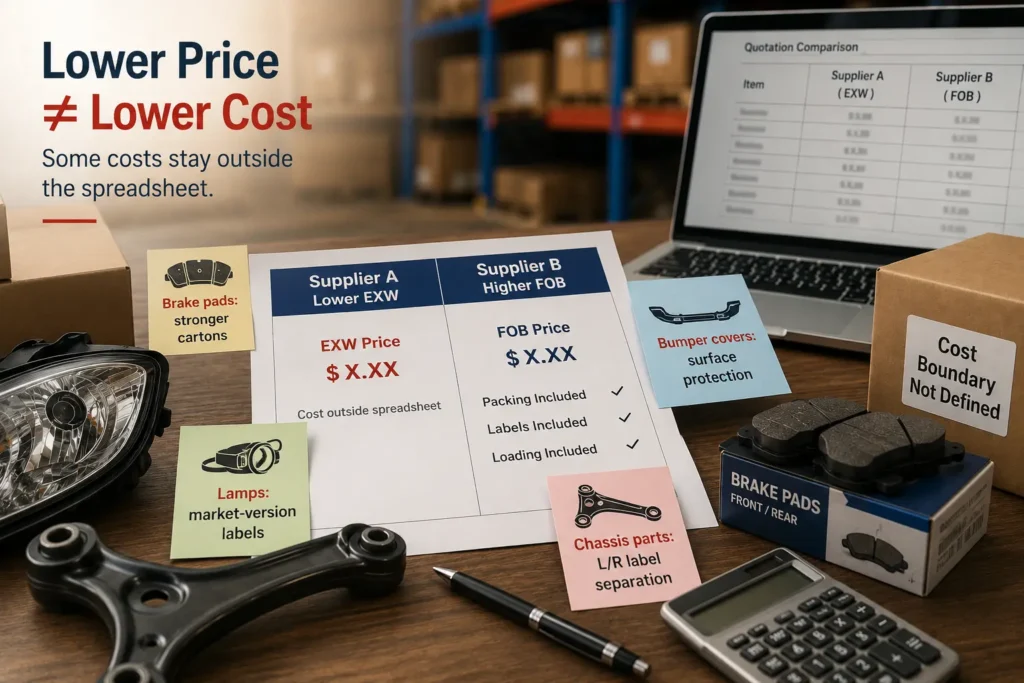
An importer receives two quotes for the same mixed auto parts order. Supplier A gives a lower EXW price. Supplier B gives a slightly higher FOB price. At first glance, Supplier A looks cheaper. On a unit-price basis, it may be.
Then the details appear. The brake pads need stronger cartons because the order includes both front and rear sets. Lamps need market-version labels because one side is for a right-hand-drive market. Bumper covers need surface protection because sensor hole position and finish condition affect resale. Several chassis parts still need left-right label separation. A few lines carry OE replacement notes rather than confirmed OE matches.
At that point, the cheaper quote is no longer obviously cheaper. It is simply the one where more costs are still waiting outside the spreadsheet.
In Part 1, we explained why a fast price still needs version confirmation. In Part 2, we showed how auto parts order quantity changes price, freight, and lead time.
This article goes one step further. After the price arrives and the quantity is confirmed, the remaining question is not only which supplier is cheaper. It is which quote has a clearer cost boundary. That comparison also depends on whether both quotations describe the same commercial product. Part 4 explains why genuine, OEM/OES, aftermarket, and remanufactured supply types must be confirmed before their prices can be treated as comparable.
A useful auto parts price comparison does not ask only which unit price is lower. It asks which quote has a cost boundary clear enough to survive packing, freight, customs, and local distribution without producing new cost lines along the way.
Auto Parts Price Comparison Starts After the Unit Price
Many importers start a price comparison by looking at the first visible number: EXW, FOB, or a unit price inside a spreadsheet.
It feels efficient because it gives something easy to rank.
In real importing, however, the unit price is only where the comparison begins. It is not where it ends.
A brake pad set with a lower EXW price may still carry a higher total cost if weak packing increases damage risk, carton weight affects freight, or domestic consolidation adds time. A bumper cover with a lower FOB price may still become expensive if the quote excludes reinforced packing, wooden support, or surface protection film. A headlamp may look cheap until the buyer learns that market-version labels, side-position marks, and stronger export cartons cost extra.
A low price without a clear boundary cannot support a fair auto parts price comparison. The buyer may be comparing one complete quote against another that still has costs waiting to surface.
How that gap appears depends on the trade term behind the price.
Auto Parts Price Comparison Must Check EXW and FOB Cost Boundaries
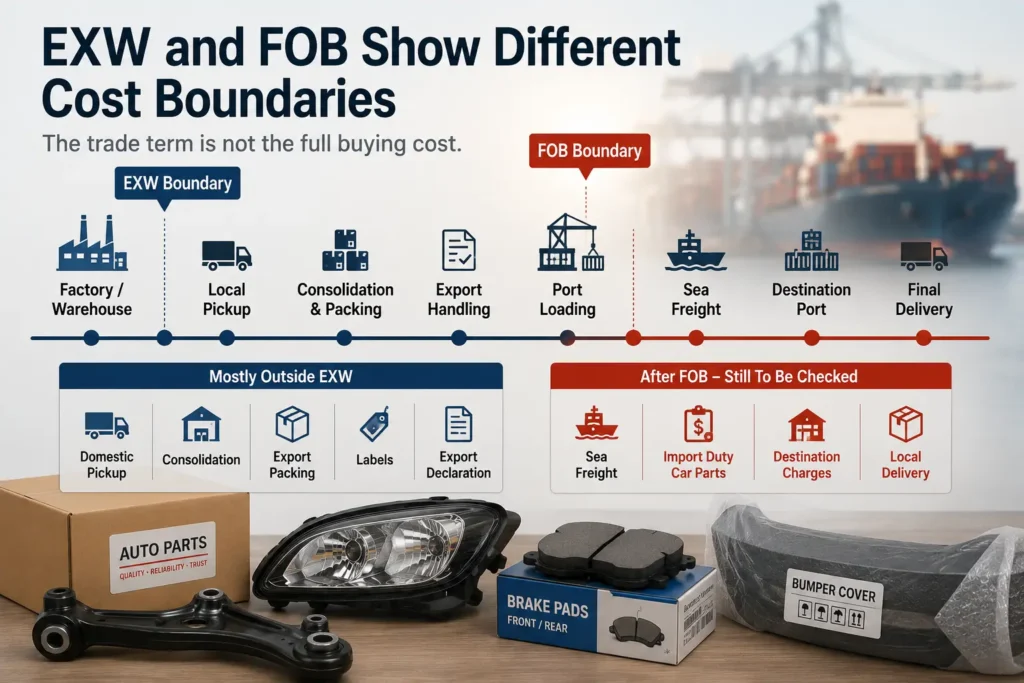
EXW and FOB are not simply different price levels for the same thing. They are part of the Incoterms® framework, which defines trade responsibilities, costs, and risks between buyer and seller.
They represent different points where the cost boundary stops. Understanding where each one stops is part of what makes a real auto parts price comparison possible.
An auto parts EXW price stops at the supplier’s warehouse or factory gate. Everything after that point may sit outside the quote: domestic pickup, local transport, export declaration, warehouse consolidation, loading, and sometimes label preparation.
In a mixed SKU order, this matters quickly.
Filters may come from one warehouse. Brake pads may come from another. Bumper covers may come from a third. In that situation, the EXW unit price does not tell the full story. Consolidation time, packing review, and label control across multiple sources all affect the real buying cost before the goods even reach the port.
An auto parts FOB price moves the boundary closer to shipment, but it does not close every gap.
Two suppliers can both write FOB on a quotation while including very different things. One may cover basic export handling only. Another may include better cartons, side-position labels, pallet planning, and pre-loading inspection. A third may quote a lower FOB number but charge separately for packing materials, barcode labels, or certificate preparation.
The trade term is the same, but the cost boundary behind it may differ significantly.
Beyond the boundary question, freight and duty add the next layer. For some markets, import duty on car parts can change the final buying cost more than a small unit price difference. Bulky and fragile parts such as bumpers, radiators, and lamps change the freight profile before the freight quote is even requested, because packing volume affects chargeable weight regardless of unit value.
An auto parts landed cost comparison that starts with EXW or FOB and stops there is not yet a comparison. It is only a starting point.
Auto Parts Cost Comparison Fails When Quote Boundaries Are Missing
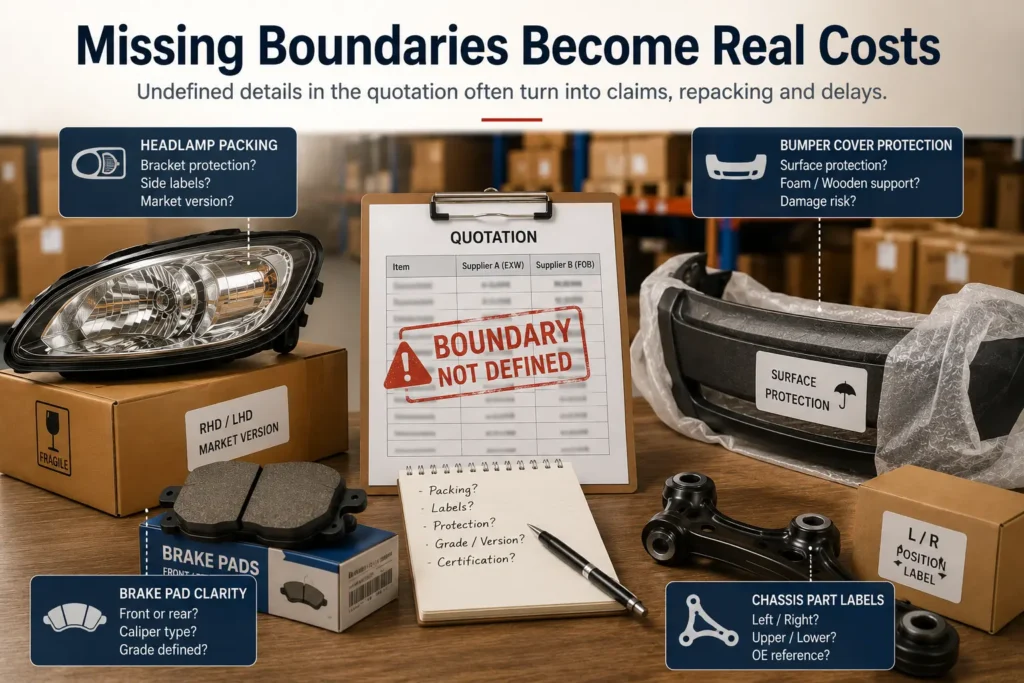
What importers call hidden costs are usually not hidden at all.
The quotation did not define them at the start, so they surfaced later at packing, freight forwarding, customs, or the destination warehouse.
The gap between a cheap-looking quote and an expensive order almost always traces back to a boundary question that was never asked.
Headlamp Packing Can Turn Into Claim Cost
A basic export carton may look acceptable in the quote. Without bracket protection, side-position labels, and market-version marks, broken tabs and sorting work at destination appear as claims instead of planned packing costs.
Bumper Cover Protection Changes the Real FOB Cost
Some FOB quotes exclude surface protection film and wooden corner support. During comparison, the better-packed quote may look more expensive. After arrival, it often costs less because surface marks, repacking work, and resale problems have been avoided.
Brake Pad Prices Need Position and Grade Clarity
A quote that mixes front and rear positions, or leaves grade undefined, produces a unit price that cannot be fairly compared against one that separates axle position, caliper type, and grade clearly.
Chassis Parts Need Side Labels Before Shipment
Without left-right position labels on control arms and tie rods, the destination warehouse absorbs the sorting cost. That cost should have been a packing specification, not an arrival problem.
Certification and compliance costs follow the same logic.
Some markets require additional documents, local-language labels, or product certification before importers can clear or resell the goods. An auto parts certification cost that appears after the purchase order is approved is not a new cost. It was always there. It simply did not enter the quotation boundary.
This is why car parts cost comparison cannot stop at EXW or FOB.
A quote may be lower on the product line but higher once packing, freight, duty, labels, certification, and warehouse handling enter the calculation.
Weak Price Signals vs Strong Cost Signals in Auto Parts Price Comparison
Weak price signals do not mean the buyer is careless.
They mean the quote does not yet show enough cost structure for a real buying decision.
Choosing EXW Without Checking What Sits After It
Selecting the lowest EXW price before consolidation, packing, and label costs are visible keeps the comparison at the factory-gate level. It may help early discussion, but domestic transport, multi-source consolidation, and export handling are still open. A stronger comparison keeps post-EXW costs visible before the buyer decides which offer is actually lower.
Accepting FOB as a Complete Cost Without Checking the Next Layer
Accepting FOB as the final comparison point before freight, duty, local clearance, and delivery checks creates a gap that only appears later. The price is closer to shipment, but the auto parts landed cost is still incomplete, and two FOB quotes from different suppliers may not include the same things. A stronger signal reviews FOB together with freight method, shipment volume, packing format, destination charges, and duty exposure.
Comparing Prices Before Version and Grade Are Confirmed
Comparing two quotes before OE, market version, side position, year range, and product grade are confirmed to match creates false savings. A car spare parts price comparison built on different product definitions does not show which supplier is cheaper. It shows which supplier quoted a different product. When both quotes refer to the same product and specification, the lowest number has meaning. Until then, it is a ranking of assumptions, not a ranking of costs.
Auto Parts Wholesale Price Comparison Must Account for Shipment Reality
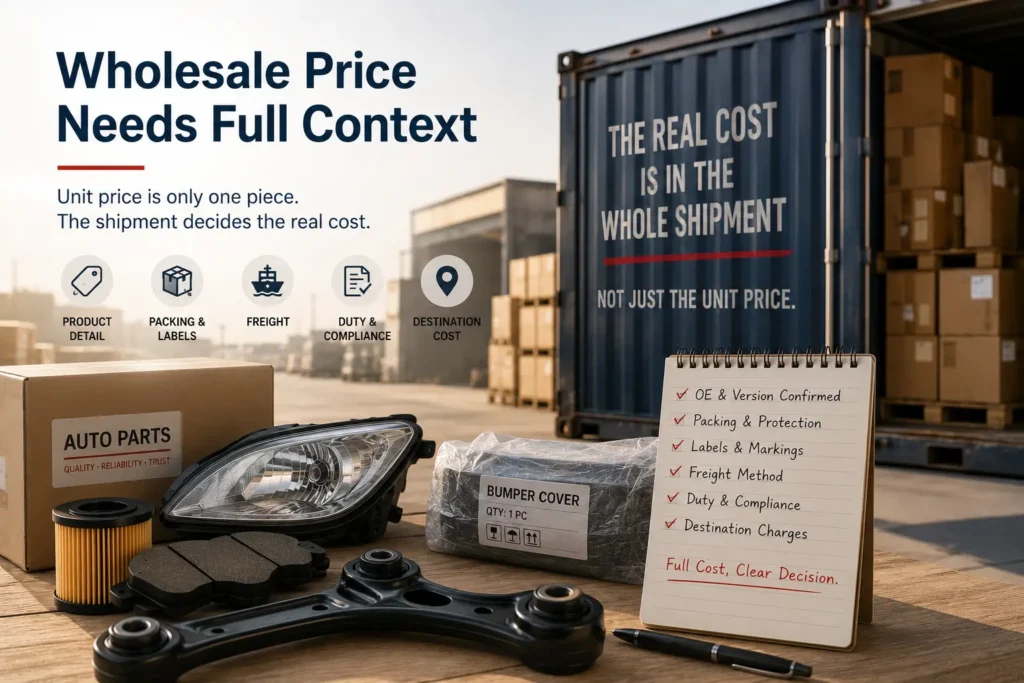
For importers, wholesalers, and distributors managing mixed orders, auto parts wholesale price comparison is most useful when it reflects how the order actually moves.
A quote for 500 oil filters with confirmed OE, quantity, and packing is straightforward to compare. A quote for 40 SKUs is different, because the freight and packing behavior of each part type creates a cost profile that only becomes visible when the buyer checks the full consignment together.
Filters pack tightly and move efficiently at most quantities. Brake pads are compact but need axle-position separation in the carton. Lamps require protective packing and market-version label control. Bumper covers dominate volumetric weight and may need wooden support for container shipment. Chassis parts with side or position differences need label clarity to prevent destination-warehouse sorting costs.
None of these dimensions appear clearly in the unit price column, but each one affects the real buying cost.
A wholesale auto parts quote should therefore confirm which lines carry verified OE numbers and version status, which lines still have open packing or label questions, which costs sit inside the quoted trade term and which remain outside it, and whether the freight mode matches the actual volume and weight of the full consignment.
A spare parts quotation that leaves these points undefined may look efficient. In practice, it is a price list that has not yet become an order.
Bilink Auto Parts View: A Quote Is Useful Only When the Cost Boundary Is Clear
At Bilink Auto Parts, we do not treat a low price as a ready quotation until the cost boundary behind it is defined.
A product price can be low and still be incomplete. The quote still needs to show what it includes, what it excludes, and which conditions remain open before the order can move.
For mixed auto parts orders, we check the product definition and the cost definition together. OE, market version, side position, year range, and plug type determine whether the quoted part is correct. Packing format, label requirements, freight basis, duty exposure, and certification needs determine whether the quoted cost is usable.
Separating these two checks is where cost surprises originate. A quote with the right part but an unclear cost boundary creates cost increases later, while a quote with a low price but an unclear version creates wrong stock.
For importers, the point is not to avoid low prices. It is to know why a price is low. A low quote with a clear version, confirmed grade, defined packing, and visible cost boundary can be a good offer. A low quote where those points are missing is not yet cheap. It is unfinished.
For mixed orders, this is why we review version, packing, freight basis, and cost boundary before treating a low quote as ready.
Order Control Series · Bilink Auto Parts
This article is part of Bilink Auto Parts’ Order Control Series for importers, wholesalers, and distributors managing mixed auto parts orders.
Part 1: Car Parts Quotation: Why a Fast Price Still Needs Version Confirmation
A fast price is useful only when the quoted price belongs to the correct version.
Part 2: Auto Parts Order Quantity: How It Changes Price, Freight, and Lead Time
Quantity is useful only when it matches the sourcing, packing, freight, lead time, and version-control logic behind the order.
Part 3: Auto Parts Price Comparison: Why EXW and FOB Prices Do Not Show the Full Cost
A price is useful only when the cost boundary behind the quote is clear.
Part 4: Genuine Auto Parts vs OEM/OES, Aftermarket, and Remanufactured Parts: What Importers Must Confirm
A quotation becomes comparable only after the buyer defines the required supply type.
For a quotation review, include the required supply type, EXW or FOB basis, item quantities, destination and packing requirements when you send your parts list.