

A buyer is preparing to import auto parts from China.
The RFQ looks normal at first: around 40 lines, some with OE numbers, some with only vehicle names, and a few configuration-sensitive parts identified by VIN. One mirror line has no old-part photo. One bumper is described as “with sensor holes,” but no front-view picture is attached.
Then the quotes arrive.
Supplier A replies in 20 minutes with a clean price list. Every line has a price, the message is confident, and the file looks easy to approve.
Supplier B takes longer. Instead of sending a clean price list, they ask whether the mirror has heating, whether the headlamp is LED or halogen, and whether connector photos are available. They also mark two items as pending and split the lead time for several SKUs.
Most buyers will feel better about Supplier A at first — and that preference is exactly where the risk starts.
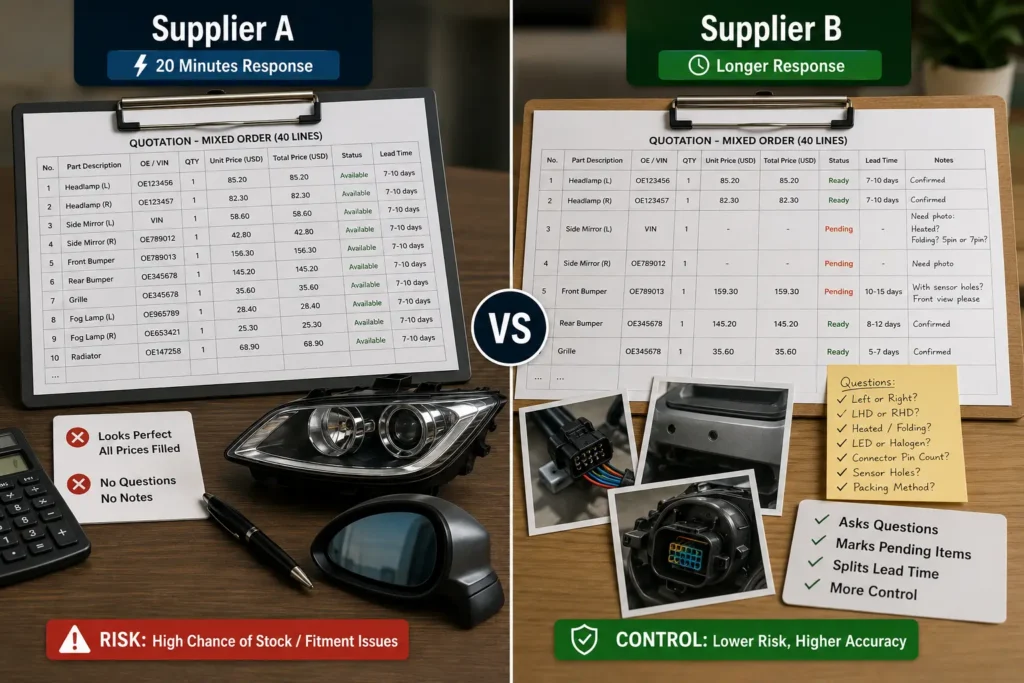
In aftermarket sourcing, real control often feels less smooth than a perfect quote. It may appear as a pending line, a version warning, a request for photos, or a slower answer on one risky SKU. These interruptions are not always inefficiency. Often, they are the supplier trying to stop a weak order before it becomes a shipment problem.
This article brings together the first five articles in the Procurement Signals series. The point is simple: before buyers import auto parts, they should not only compare prices. They should read supplier behavior.
Why Import Auto Parts Orders Can Fail Before Shipping
Most wrong-part problems are discovered after delivery, but they usually start much earlier.
The first weak point may be a vague RFQ: no OE, no side, no year range, no LHD/RHD note, and no old-part photo. Another weak point may be a supplier quoting from a list without checking the actual warehouse batch. Sometimes the risk starts when confirmed and unconfirmed items are mixed into one clean-looking order, so nobody remembers which lines still need verification.
Low price can also create a false sense of control. If the product definition is loose, a cheap quote may only mean the supplier has widened the replacement range, weakened the packing, or skipped a configuration check.
Buyers who import auto parts successfully do not read only the quotation sheet. They read what happened before the quotation became clean.
That is what procurement signals are for.
Signal 1: Fast Quotes Can Hide Warehouse Reality
Speed feels professional. It helps the buyer move forward and reduces waiting time. However, a fast quote on a mixed order does not always mean the stock, packing, and version details have been checked.
A sales team may quote “available” from a digital list before warehouse staff checks the real batch. A product may exist in the system, but not as clean, shippable stock. Mixed SKUs may look fine on paper, while the warehouse later finds that one item needs repacking, one item is short, and one item comes from a different source.
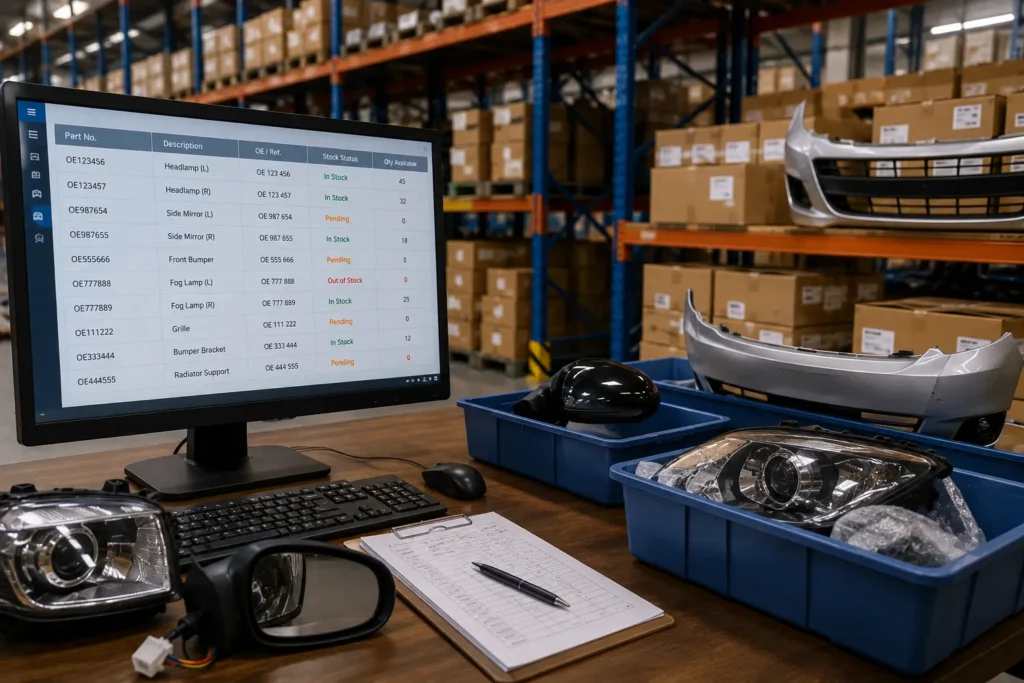
The warehouse gap behind a fast reply is the main topic of Procurement Signals #1: The Sales Echo vs. Warehouse Reality. It is worth reading before sending a deposit on a mixed order.
The issue is not that fast suppliers are always weak. The issue is that speed needs proof.
A stronger supplier may still reply quickly, but the reply usually carries signs of warehouse reality. Ready items are separated from pending items. Lead times are split instead of forced into one number. Stock is confirmed by batch or source, not just by list. Packing limits are mentioned before payment, not after the goods are already being prepared.
That answer may look less perfect. For an importer, it is more useful.
Signal 2: Technical Questions Are Control, Not Delay
Some buyers get impatient when a supplier asks questions after receiving VINs, OE numbers, or product names. They expected a price, not another round of checking.
That reaction is common, but it can be expensive.
For many aftermarket parts, the question is the first real control step. A mirror is not only “left mirror.” It may be electric folding, manual folding, heated, non-heated, with camera, without camera, 5-pin, 7-pin, or market-specific. A headlamp is not only “headlight.” It may be LED, halogen, LHD, RHD, with leveling motor, or with a different plug layout.
This is the reason Procurement Signals #2: Technical Curiosity Is Not Delay. It Is Control sits early in the series. It deals with the kind of questions that look inconvenient during quotation but prevent expensive corrections later.
When buyers import auto parts, the cheapest correction is the one made before purchase. Asking for a connector photo costs a few minutes. Discovering the wrong connector after the goods arrive can cost freight, local handling, workshop time, and customer trust.
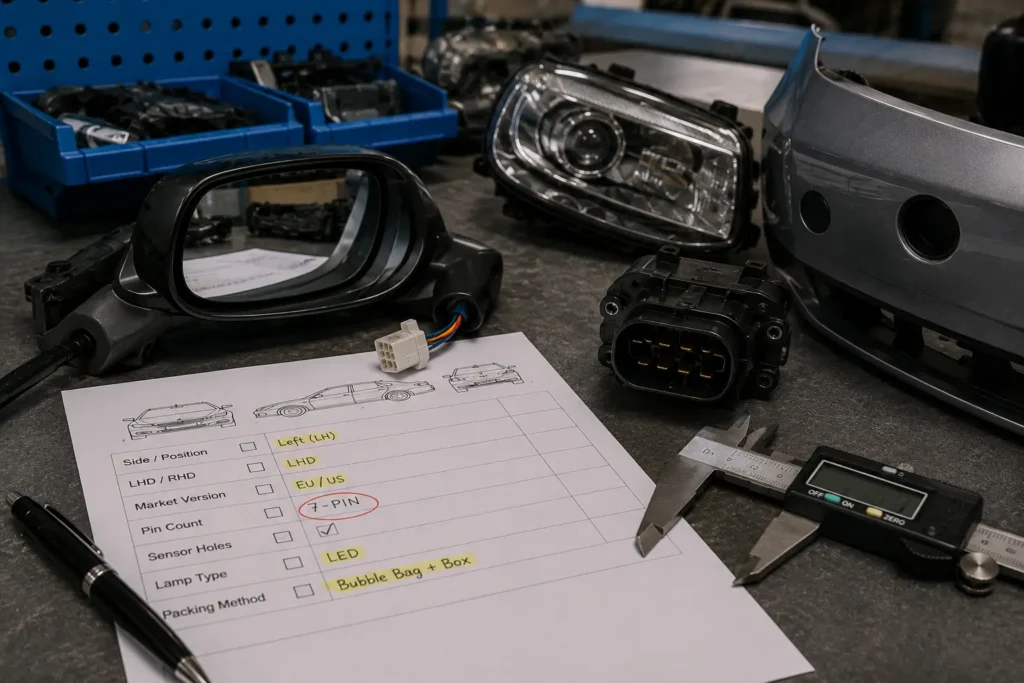
A supplier who asks about side, position, market version, pin count, sensor holes, lamp type, and packing method may not be slowing the order down. They may be stopping the wrong order from moving too fast.
Signal 3: Some Questions Are Only Theater
There is another trap: not every question proves control.
Some suppliers ask for photos because it looks professional, then quote the same generic item anyway. Others request VINs but never change the part selection. Even detailed questions mean little when the final quote has no version note, no pending line, no packing remark, and no change in lead time.
That is question theater.
The practical test is not “Did they ask questions?” The test is: what did those questions change?
Did the supplier update the OE reference?
Did they change the quoted version?
Did they add a packing note?
Did they mark one SKU as pending?
Did they split the lead time?
Did they exclude a risky replacement?
If nothing changed, the question may have been only a performance.
The difference between a real control question and a performance question comes down to its result. Procurement Signals #3: Not Every Question Is Control. Some Are Just Theater focuses on that distinction and gives more examples from RFQ handling.
Real control leaves traces. It shows up in the quote, the remarks column, the pending lines, the packing notes, or the decision to hold one item before purchase. Before buyers import auto parts from a new supplier, they should check whether the supplier’s questions actually changed the order.
Signal 4: Low Price Can Move Risk Into the Future
A low price is not automatically a problem.
Sometimes a supplier has better factory access or existing stock. In other cases, the MOQ works in the buyer’s favor, or the supplier can combine several items efficiently.
In those cases, the low price reflects a real advantage, not a definition gap. That distinction matters.
The problem starts when the low price comes from a looser product definition.
Was the grade changed?
Was the OE relationship widened?
Was the packing simplified?
Was the replacement logic stretched too far?
Was a configuration-sensitive part quoted without photo confirmation?
These are not small details once the goods cross borders.
This is why Procurement Signals #4: Low Price Is Not Control. It Is Often Deferred Risk belongs in the series. It explains how the lowest quote can look attractive while pushing cost into claims, delays, and customer pressure.
The better question is not only “Can you lower the price?”
The better question is:
What changed to make this price possible?
A supplier who can explain the grade, source, packing method, MOQ, lead time, and replacement boundary is giving the buyer something to judge. A supplier who cannot explain the low price may simply be passing the risk forward.
For importers, this matters. After goods ship, a small definition gap can turn into return freight, local inspection cost, repair delay, and customer pressure.
Signal 5: VIN Helps, but Photos Close the Last Gap
VIN is useful. It is much stronger than a loose vehicle description like “2019 Haval headlamp” or “GWM Poer mirror.”
But VIN is not a magic answer.
For standard parts, VIN and OE confirmation may be enough. For configuration-sensitive parts, the buyer often needs one more layer of evidence.
A side mirror may differ by folding function, heating, camera, blind spot, connector, or market version. A headlamp may differ by LED or halogen type, DRL design, beam pattern, motor function, or plug layout. A bumper may differ by sensor holes, washer holes, fog lamp openings, radar brackets, or camera position.
That is the problem handled in Procurement Signals #5: Car Parts by VIN Still Need Photo Confirmation. It moves from supplier behavior into part identification, which is often where configuration-sensitive orders fail.
The rule is direct:
VIN opens the catalog. Photos close the risk.
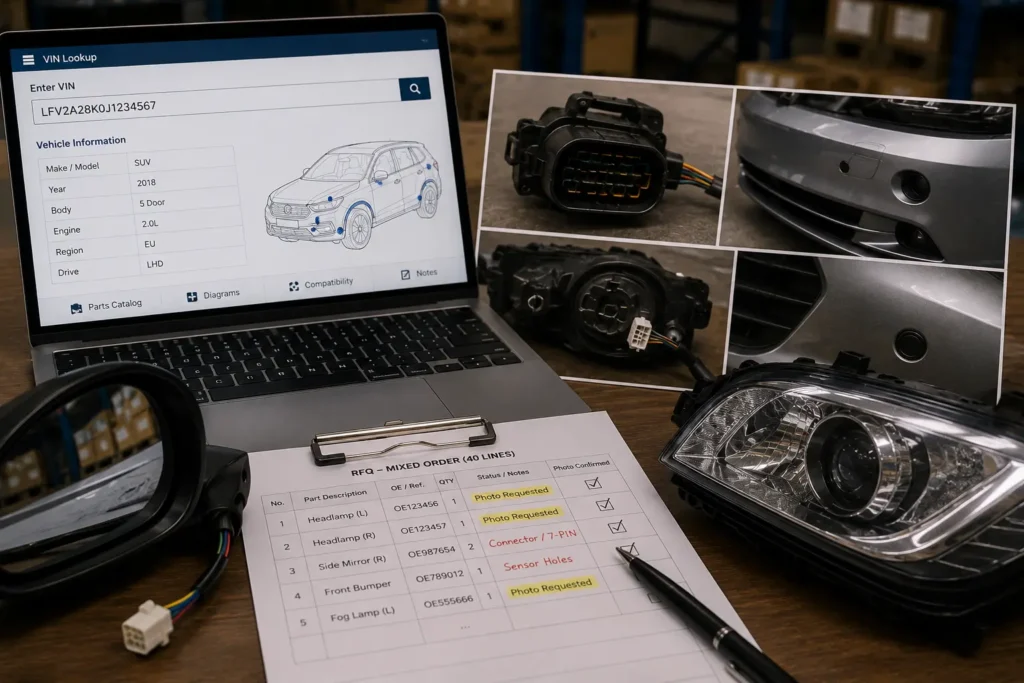
For buyers who import auto parts in mixed orders, this is not extra paperwork. It is one of the simplest ways to prevent claims on mirrors, headlamps, bumpers, grilles, switch panels, tail lamps, radar brackets, and camera-related trims.
How Buyers Should Read Suppliers Before They Import Auto Parts
The five signals should be read together.
A fast reply is useful only when it reflects stock and warehouse reality. A technical question is useful only when it reduces real uncertainty. A supplier’s question matters only when it changes the quote, the lead time, the packing, or the handling of a risky SKU. A low price is safe only when the supplier can explain what made it possible. A VIN is reliable only when configuration-sensitive parts still receive photo confirmation.
The wrong way to choose a supplier is to trust the most confident answer.
The fastest reply may not reflect a checked warehouse. The most confident quote may not reflect a confirmed version. The cheapest price may not reflect the same product definition. The supplier who asks no questions may simply be carrying the buyer’s uncertainty forward.
The better method is to look at supplier behavior when the order is still unclear.
Does the supplier slow down risky lines?
Do they separate confirmed items from pending items?
Do they explain price differences?
Do they ask for photos when configuration matters?
Do they change the quote when new evidence appears?
This is where control becomes visible.
Checklist Before Buyers Importing Auto Parts
Before approving a mixed order, buyers should check the order line by line.
RFQ structure
Are OE numbers, VINs, photos, left/right sides, front/rear positions, year range, and market version clearly separated? Are LHD/RHD requirements written down where they matter?
Stock reality
Did the supplier confirm real stock by batch or source, or only quote from a catalog list?
Fitment risk
Did the supplier ask about the parts that can actually differ, such as connector pin count, sensor hole count, folding function, beam pattern, plug type, or radar bracket?
Question outcome
Did the supplier’s questions change the part number, quoted version, price, lead time, packing note, or order status?
Price definition
Can the supplier explain the grade, source, OE relationship, packing method, MOQ, and replacement boundary behind the price?
VIN scope
For mirrors, headlamps, bumpers, grilles, and electrical-function parts, did the order include photo confirmation beyond VIN alone?
Pending lines
Were unclear SKUs held separately before purchase, or were they quietly included in the approved order?
None of this requires complicated tools.
It requires the buyer to read the order before the order creates the problem.
The Bilink Auto Parts View
At Bilink Auto Parts, we do not treat quoting as the end of sourcing. It is closer to the middle.
When an importer sends us a mixed order, our job is not to make the file look complete while the order is still weak. When a line needs a photo before version confirmation, we ask for the photo. If an OE has two valid options depending on production year or market, we flag it. A low price that requires a different product definition should be explained before the invoice, not after the shipment.
We would rather mark one line as pending than ship one wrong part. We would rather ask one more question than send a confident quote that creates a claim three weeks later.
That friction at the front end is cheaper than friction at delivery. It is cheaper for the buyer, and it is cheaper for us.
The best time to catch a version mismatch is when the order is still a spreadsheet. The worst time is when the buyer’s customer already has the box open.
That is why the Procurement Signals series exists: not to make sourcing sound complicated, but to help buyers read supplier behavior before they import auto parts and before the order is already moving.
Continue Reading the Procurement Signals Series
Start with Procurement Signals #1: The Sales Echo vs. Warehouse Reality.
Then read Procurement Signals #2: Technical Curiosity Is Not Delay. It Is Control.
Continue with Procurement Signals #3: Not Every Question Is Control. Some Are Just Theater.
Next, read Procurement Signals #4: Low Price Is Not Control. It Is Often Deferred Risk.
For VIN and photo confirmation, read Procurement Signals #5: Car Parts by VIN Still Need Photo Confirmation.
Use these supplier checks when preparing an enquiry: send the parts list for review with reference numbers, quantities, destination and any unresolved version questions.