

Continue in the Procurement Signals Series
Previously in this series:
Full series framework: Procurement Signals: What Buyers Should Check Before They Import Auto Parts.
Procurement Signals #1: The Sales Echo vs. Warehouse Reality.
Procurement Signals #2: Technical Curiosity Is Not Delay. It Is Control.
Procurement Signals #4: Low Price Is Not Control. It Is Often Deferred Risk.
Procurement Signals #5: Car Parts by VIN Still Need Photo Confirmation.
Procurement Signals #3: Not Every Question Is Control. Some Are Just Theater.
In #1, we exposed the fast quote that dies the moment it hits the warehouse.
In #2, we showed why real technical curiosity is control, not delay.
Now we go one layer deeper.
For buyers comparing automotive parts wholesalers, the real test is not who asks questions first, but whose questions actually change the quote.
Even when a supplier asks questions, not every question is trying to protect your order.
Some suppliers verify. Others perform, and in real auto parts trade that performance is expensive.
That is exactly why experienced buyers do not judge automotive parts wholesalers by tone, speed, or politeness alone.
At 9 a.m. you send the same RFQ to 12 Chinese wholesalers for one mixed 40HQ: mirrors, grilles, lamps, control arms, and chassis parts for Toyota RAV4 and Camry facelift models. Four suppliers reply within hours. All four ask the exact same things: facelift or pre-facelift, LHD or RHD, 7-wire or 9-wire, radar hole or none, standard carton or reinforced pallet.
On paper they all look careful.
They are not. One is trying to stop a mistake, while the other three are trying to stay safe while keeping the quote easy.
The Confirmation Trap Automotive Parts Wholesalers Use
Most buyers still believe a technical question means the supplier is being responsible.
Sometimes the opposite is true.
A weak supplier asks because he wants your confirmation on record — not your answer, your screenshot.
He wants one line that says Confirmed so later, when the mirror will not fold or the lamp throws a fault code, he can reply:
“You confirmed the version.”
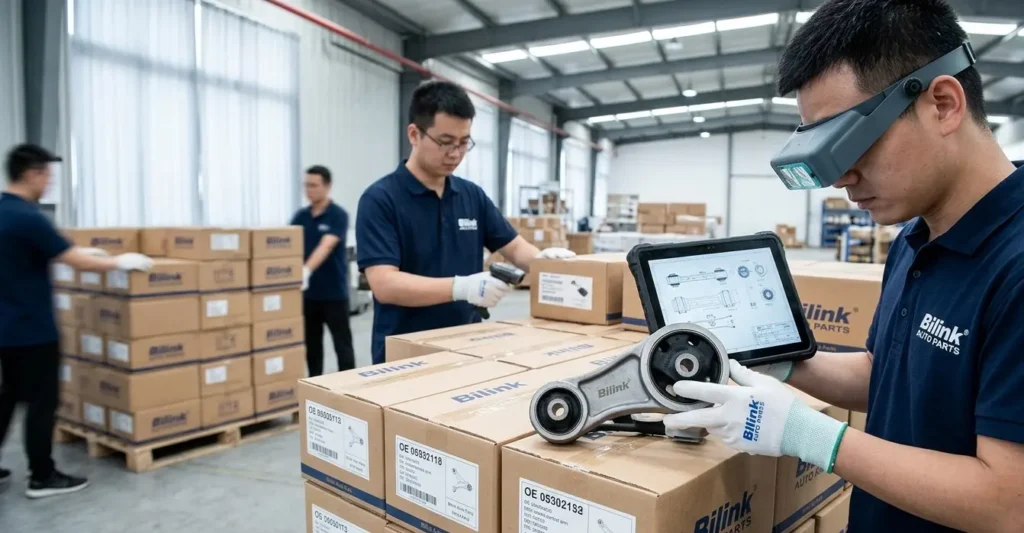
That is not verification.
That is evidence collection.
Instead, a real supplier acts like a doctor, not a witness.
He does not just ask, “7-wire or 9-wire?”
He says:
“This chassis variant usually needs the reinforced arm. The standard one may install but will start making noise after a few hundred kilometers. We should switch version — unit price goes up $3. Do you want the cheaper part, or the part that lasts?”
The first supplier moves risk onto your reply.
The second stops risk before it enters the container.
Why Automotive Parts Wholesalers Turn Questions into Theater
They do it for three practical reasons.
They do not actually know the answer yet. Stock, batch, and version may still be unclear, so they buy 24–48 hours while scanning the market.
They want to protect a clean, attractive quotation. Real answers force price increases, longer lead times, packing surcharges, exclusions, or hold lines. That makes the PI ugly and harder to sell.
They fear internal consequences. Lose the order, boss asks why. Raise the price, customer disappears.
So they ask just enough to sound serious, then send back the same unchanged, beautiful spreadsheet.
The Only Rule Automotive Parts Wholesalers Cannot Hide From
If the question does not change the quote, it did not change the risk.
That rule matters most when you compare automotive parts wholesalers who sound equally technical but behave very differently on paper.
That is the only rule you need.
A supplier asks about connector pins, you answer, and the quote stays identical.
A supplier asks about facelift year, you answer, and the fitment line stays broad.
A supplier asks about packing, you answer, and the PI still shows zero remarks, zero exclusions, and zero added conditions.
Then nothing was controlled.
The seller collected your answers without accepting any commercial consequence.
The risk is still alive.
It has simply moved closer to your warehouse.
How Automotive Parts Wholesalers Leave Real Verification Fingerprints
Fitment boundaries tighten
A performative supplier asks about harness count, radar hole, or bushing hardness, then still quotes the universal line.
By contrast, a real supplier lets the answer break the quote:
“Price valid for 9-wire mirror only. 7-wire excluded until plug photo matches. Radar-hole grille quoted separately. Reinforced control arm required for this chassis — standard version not recommended.”
A part can match the catalog title and still fail in the workshop. One wrong mirror, grille, control arm, or bracket can create ECU faults, noise after 300 km, or tolerance problems.
Stock commitment narrows
“All available” is one of the most dangerous phrases in wholesale.
A real supplier replies:
“120 pcs confirmed in exact 2022 9-wire batch. Remaining 80 pcs pending batch photo verification within 48 hours. If batch differs, we hold and re-quote.”
That is what stock truth sounds like. This is also why the aftermarket relies on structured fitment and product information standards such as ACES and PIES.
Packing becomes commercial terms
A performative supplier asks about mixed cargo, then the PI stays silent.
A real supplier adds:
“Reinforced pallet required. Heavy control arms cannot sit on lamp cartons. Mirror assemblies need edge protectors and This Side Up marks. Inner labels must show OE + your SKU + batch. Packing cost excluded until pallet method agreed.”
Weak suppliers also reveal themselves by what they never ask: bracket tolerance compensation, rubber hardness consistency, mixed-batch appearance differences, pallet weight conflict, or how long a fragile item survives under stacked load.
That silence is not efficiency.
It is cost avoidance.
The Real Cost Chain
Supplier asks ten technical questions.
You feel reassured.
Quote stays clean.
PO issued. Deposit paid. Booking locked. Container sails.
Then the container opens.
Workshop cannot plug in the mirror.
Lamp throws fault codes.
Control arm makes noise after 300 km.
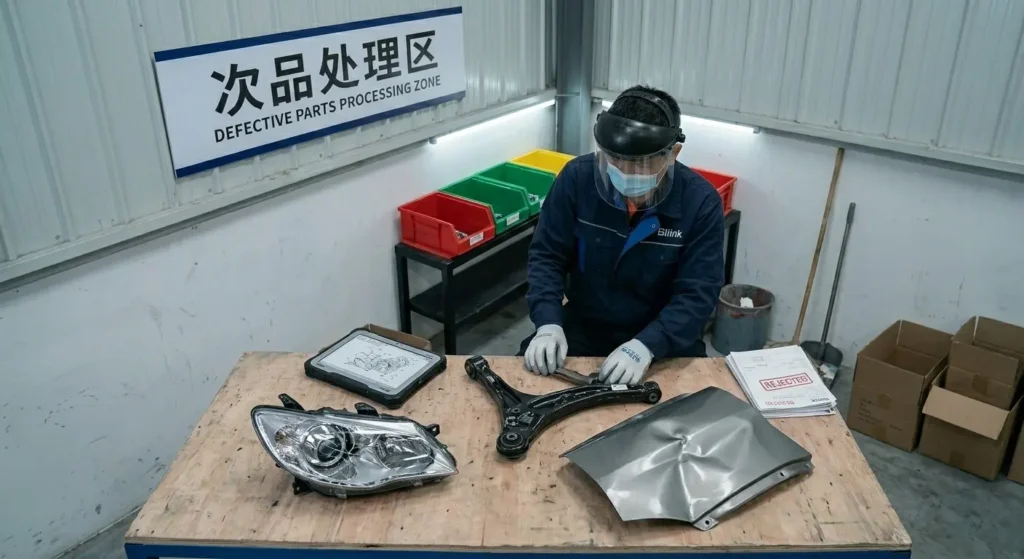
Six headlight lenses are crushed because no stacking rule was written into the PI.
Warehouse spends two days re-sorting because labels were never defined.
Customer refuses three SKUs.
Your margin disappears into storage, labor, rework, claims, and partial air freight.
That is the real meaning of risk transfer.
The Fingerprint Test For Automotive Parts Wholesalers
Look at the returned quote and ask three questions only:
Did the price change on any line?
Did remarks, conditions, or exclusions appear?
Did any line get narrowed, split, or put on hold?
If the answer is no, it was performance. Risk is still 100% on you.
Real verification always leaves fingerprints:
“Price valid only for 9-wire version.”
“80 pcs held until batch photo confirmed.”
“Packing charge excluded until pallet method agreed.”
“Lead time based on exact facelift version only.”
These are not annoying details.
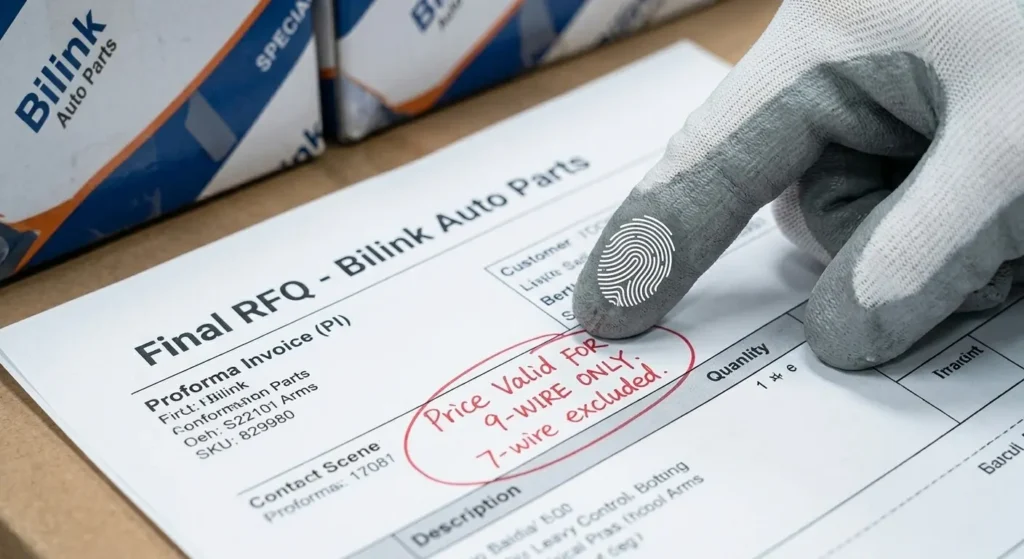
They are proof the supplier let your answers affect his own exposure.
The Bilink Auto Parts View
At Bilink Auto Parts we do not judge suppliers by how many questions they ask.
We judge them by one standard only:
Did the question leave a fingerprint on the final quote?
If it changed scope, quantity, lead time, packing terms, remarks, or exclusions, we treat it as real control.
If the quote comes back untouched, we treat the questions as performance and move on.
We are not trying to be easy during RFQ.
We are trying to make failure difficult after shipment.
Conclusion
Fast replies are not enough.
Questions are not enough either.
Only questions that change the commercial boundary are real control.
That is the signal buyers must learn to read before the container leaves port.
Not every question is control.
Some are just theater.
The real ones are the ones that leave fingerprints on the quote.
Continue in the Procurement Signals Series
This article explains why not every question creates real procurement control. Some questions only create the appearance of control.
To return to the first signal, read Procurement Signals #1: The Sales Echo vs. Warehouse Reality.
To understand why careful technical questions matter before quotation, read Procurement Signals #2: Technical Curiosity Is Not Delay. It Is Control.
To see how low quotes can move risk into the future, continue with Procurement Signals #4: Low Price Is Not Control. It Is Often Deferred Risk.
To understand VIN and photo confirmation for configuration-sensitive parts, read Procurement Signals #5: Car Parts by VIN Still Need Photo Confirmation.