

Procurement Signals Series
This article is part of our Procurement Signals series on how importers can read false signals and real control signals in auto parts sourcing.
Full series framework: Procurement Signals: What Buyers Should Check Before They Import Auto Parts.
Start with Procurement Signals #1: The Sales Echo vs. Warehouse Reality.
Procurement Signals #3: Not Every Question Is Control. Some Are Just Theater.
Procurement Signals #4: Low Price Is Not Control. It Is Often Deferred Risk.
Procurement Signals #5: Car Parts by VIN Still Need Photo Confirmation.
Procurement Signals #2: Technical Curiosity Is Not Delay. It Is Control.
In Procurement Signals #1, we exposed the Sales Echo — the fast quote that sounds professional but carries little or no real verification from the warehouse, technical side, or packing side.
This second article moves to the other side of the signal.
For buyers comparing wholesale automotive parts suppliers, the real signal is often a slower quote with better verification.
If speed is often a false signal, what does a real signal look like?
For buyers comparing wholesale automotive parts suppliers, a real signal does not feel smooth at first. You send an RFQ. Instead of a price in two minutes, you get a list of questions.
Pre-facelift or post-facelift?
Left-hand drive or right-hand drive?
3-pin or 4-pin connector?
With sensor hole or without?
Standard export packing or reinforced packing?
Mixed labels by OE or by your own SKU code?
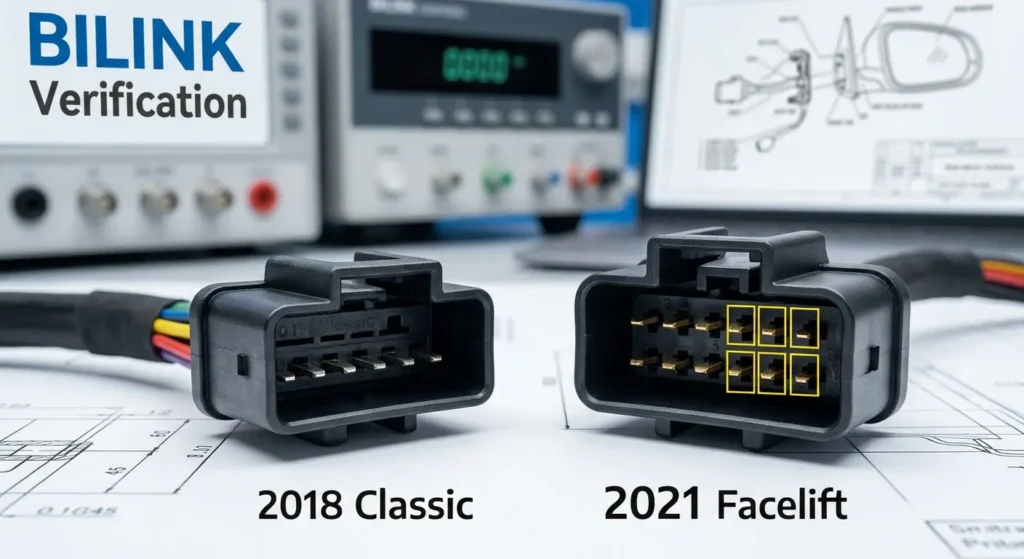
To an impatient buyer, this feels like delay. In real auto parts sourcing, it is often the first strong signal that the supplier is actually thinking about the order.
Technical curiosity is not a communication style. It is not a personality trait. It is a control action.
A supplier who asks the right questions before quoting is trying to stop the order from drifting into guesswork. He is checking whether the OE, version, interface, quantity, packaging, and loading logic can survive contact with the real product and the real shipment. This is also why the aftermarket relies on structured fitment and product information standards such as ACES and PIES, rather than treating application data like loose sales notes.
That work creates early friction. However, it prevents much larger late friction.
That is why strong wholesale automotive parts suppliers ask before they quote, instead of hiding uncertainty behind speed.
Why Wholesale Automotive Parts Suppliers Ask Before Quoting
In auto parts trade, a quotation is never just about price. It is about whether the part can be picked correctly, packed correctly, shipped correctly, installed correctly, and accepted without argument.
That is why a supplier who asks nothing may actually be giving the weakest quote in the room. He may look efficient. He may look easy to work with. He may even look cheaper.
But a quote without technical curiosity usually means one of three things.
First, it is a verification gap: the supplier has not checked enough.
Second, it is risk dumping: the supplier is assuming the buyer will absorb the mismatch.
Third, it is failure blindness: the supplier does not yet understand where the real failure points are.
None of those is a strong procurement signal.
How Wholesale Automotive Parts Suppliers Protect Orders
1. Fitment, before the wrong part enters the order
A part can match the product name and still fail at installation.
A control arm may look correct in the photo but differ in bushing layout or ball-joint angle for a specific chassis variant. A radiator fan may share the family appearance but use a different motor spec or shroud for another market. A mirror may fit the shell shape but fail on 5-wire versus 7-wire harness or folding function. A lamp may look identical from the front while the rear socket layout is completely different.
This is why serious aftermarket car parts suppliers ask about year, market, trim, side, connector, and version before anything is loaded.
2. Stock truth, before quantity becomes a promise
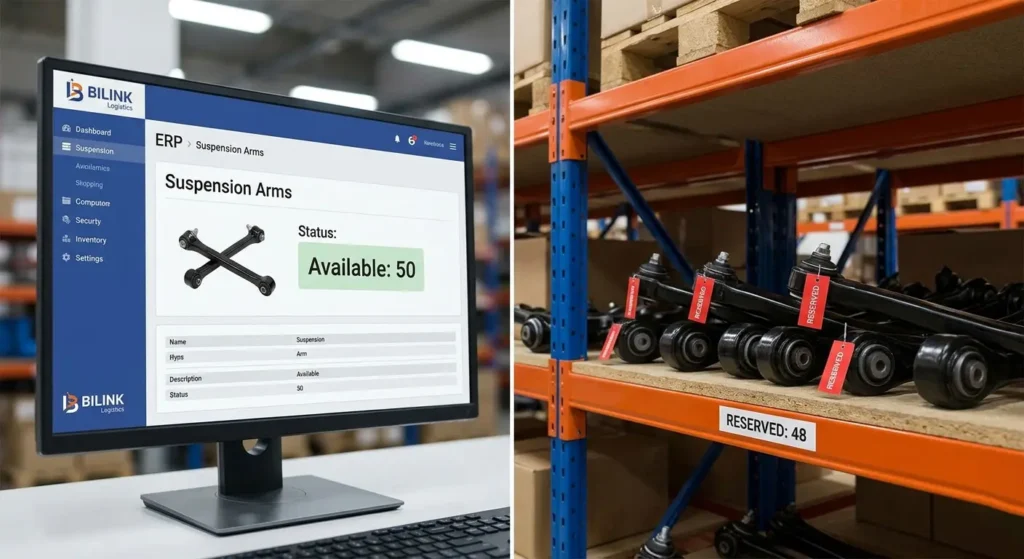
Many suppliers say “available” too early.
Real stock truth is rarely that simple. The quantity may exist but not in the exact version quoted. The goods may already be reserved for another order. The inner batch may have changed. The ERP may no longer reflect what can actually ship this week.
A supplier who asks one or two extra questions before confirming stock is preventing a quotation-stage assumption from becoming a payment-stage problem.
3. Packaging and loading, before mixed cargo turns into damage
Auto parts sourcing does not end when the item is identified.
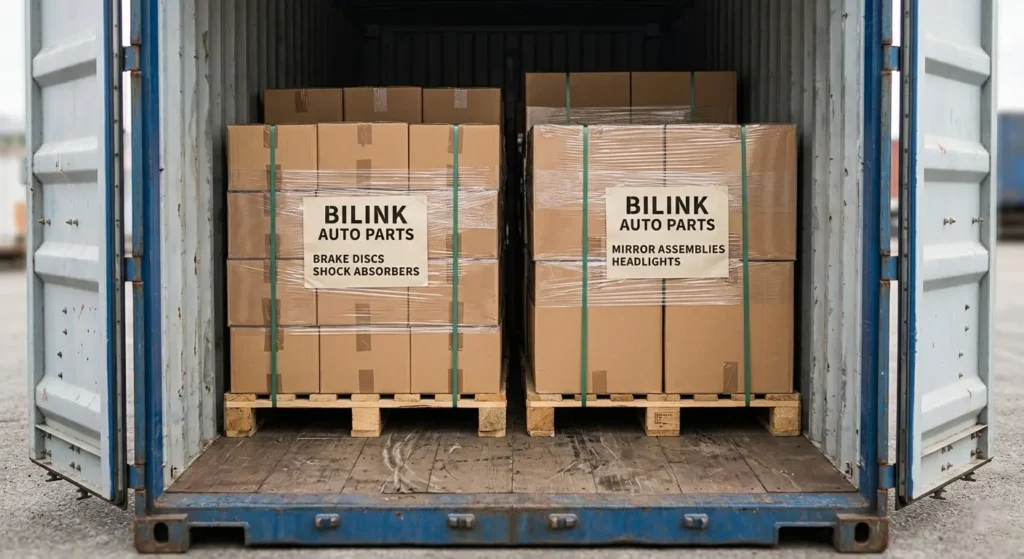
Heavy parts can crush fragile lamps. Mirror assemblies need controlled carton space and edge protection. Mixed SKUs require clear label logic that survives sea shipment and customs. Large and small cartons need proper loading order.
A supplier who asks about reinforcement, palletizing, inner labels, or mixed-load separation is checking whether the order can travel without confusion, damage, or claims.
This matters even more in car parts wholesale, where one weak line can create damage, claims, or sorting problems across the whole shipment.
4. Responsibility, before risk gets pushed downstream
This is the part many buyers fail to notice.
When a supplier does not ask enough, the missing judgment does not disappear. It simply moves.
It moves to the buyer’s warehouse.
It moves to the workshop.
It moves to the installer.
It moves to after-sales.
It moves to return freight, delay, argument, and distrust.
That convenience on the supplier side is often paid for by pain on the buyer side. Technical curiosity matters because it keeps the judgment cost where it still belongs: with the supplier, while the cost of checking is still low.
Weak Signal vs. Strong Signal
Weak Signal: Surface Questioning
Questions are generic or missing
The supplier asks once, then ignores the answer
No follow-up appears when the answer creates version risk
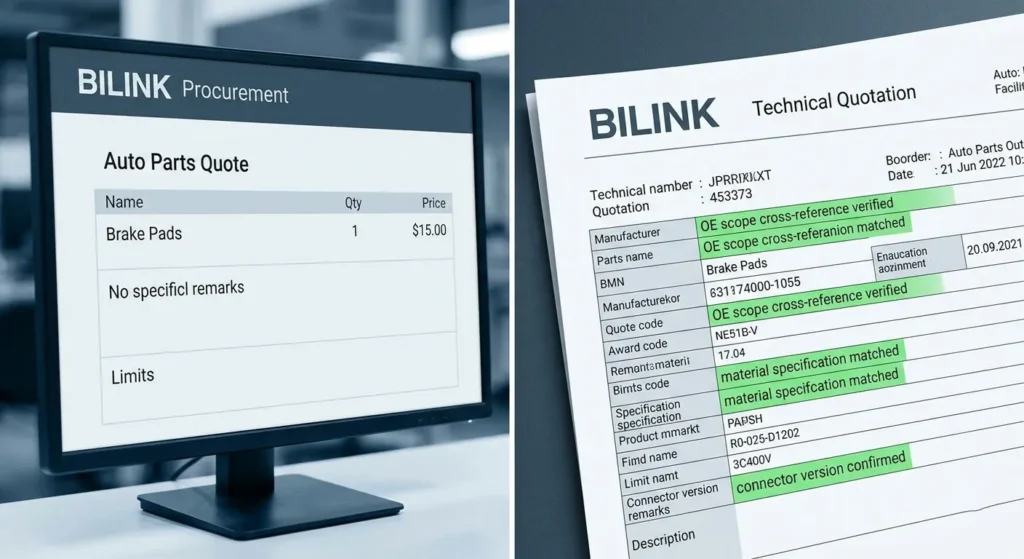
The quote comes back with no remarks, no limits, and no warnings
Everything still sounds like “no problem”
What it usually means:
The supplier is performing caution, not exercising control.
Strong Signal: Technical Curiosity
Questions go directly to fitment, version, side, interface, stock reality, or packing logic
The supplier adjusts the quotation based on the answer
Risks are flagged clearly before order confirmation
Some items are held back instead of guessed through
The quote returns with clearer remarks, boundaries, or version conditions
The final quote becomes narrower, with clearer boundaries and fewer assumptions
What it usually means:
The supplier is removing false certainty before it becomes a downstream cost.
A strong supplier does not ask questions to sound professional. He asks questions to remove guesswork.
Why Buyers Often Misread This Signal
Many buyers are trained by bad market habits. They have seen too many fast quotes. They have heard “no problem” too often. They have learned to confuse responsiveness with safety.
So when a serious supplier slows down and asks real questions, it can feel inconvenient. That feeling is understandable. But it is backward.
In this industry, the most expensive mistakes almost always begin where the quotation felt easiest. The supplier who creates a little discomfort before order confirmation is usually preventing much bigger pain after arrival.
That is why technical curiosity should be read as a positive signal, not a delay signal.
The Bilink Auto Parts View
At Bilink Auto Parts, we do not treat early questions as sales conversation. We treat them as pre-order verification and the first layer of quality control.
When we ask about OE scope, connector type, model year, market version, side position, packaging method, label rule, or mixed-load separation, we are not trying to make the RFQ heavier. We are trying to keep the process from becoming smooth too early.
Because in auto parts trade, smooth too early usually means someone skipped the hard part. And the hard part is exactly where the cost hides.
Conclusion
A fast quote can keep the conversation moving.
A careful question can keep the order from failing.
That is the difference.
Technical curiosity is not delay.
It is control.
The best early procurement signal is not the supplier who says yes immediately. It is the supplier who knows exactly what must be checked before yes means anything at all.
Continue in the Procurement Signals Series
This article explains why technical questions are not delay. They are part of procurement control.
To see the first signal in the series, read Procurement Signals #1: The Sales Echo vs. Warehouse Reality.
To separate real control questions from empty questioning, continue with Procurement Signals #3: Not Every Question Is Control. Some Are Just Theater.
To understand why low price can become delayed risk, read Procurement Signals #4: Low Price Is Not Control. It Is Often Deferred Risk.
To see why VIN still needs photos for configuration-sensitive parts, read Procurement Signals #5: Car Parts by VIN Still Need Photo Confirmation.