

Procurement Signals #5: Car Parts by VIN Still Need Photo Confirmation
When buyers search for car parts by VIN, they often expect the part to be fully confirmed.
A buyer sends a VIN for a side mirror.
The supplier checks the catalog and quotes one option.
The mirror arrives.
Its housing shape looks close.
However, the connector does not match.
Installation stops.
This is not always a careless supplier problem. It is often a weak confirmation problem.
This article continues the Procurement Signals series.
Full series framework: Procurement Signals: What Buyers Should Check Before They Import Auto Parts.
Procurement Signals #1: The Sales Echo vs. Warehouse Reality explained why a fast reply may only be a sales echo. Speed does not prove warehouse, fitment, or packing control.
Procurement Signals #2: Technical Curiosity Is Not Delay. It Is Control showed why careful technical questions protect the order before quotation.
Procurement Signals #3: Not Every Question Is Control. Some Are Just Theater separated real control questions from empty questioning.
Procurement Signals #4: Low Price Is Not Control. It Is Often Deferred Risk explained why a smooth low quote can push risk into the future.
This fifth article moves from quotation behavior to part identification.
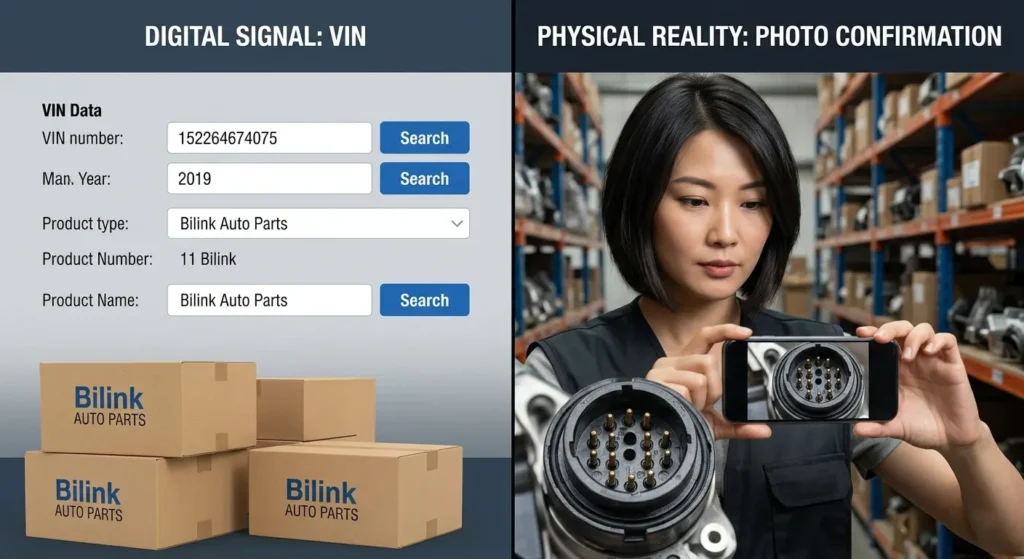
When buyers source car parts by VIN, they are using a stronger starting point. That is good. A VIN is far better than a loose model name. NHTSA says its VIN decoder can identify specific information encoded in a VIN. It also notes that displayed information comes from manufacturers. (NHTSA VIN Decoder)
But VIN is not always the final answer.
Why VIN Is Strong but Not Final
For standard service parts, a confirmed OE number often solves most of the risk. Filters, many brake components, and simple mechanical parts are usually more controllable once the correct OE is confirmed.
Configuration-sensitive parts are different.
Side mirrors, headlamps, bumpers, grilles, switch panels, tail lamps, radar brackets, and camera-related trims may depend on visible details. These include connector pins, lamp type, folding function, heating function, sensor holes, camera holes, trim level, market version, and LHD/RHD setup.
That is the real procurement signal.
VIN opens the catalog. Photos close the risk.
As a global supplier of China-made auto parts, Bilink Auto Parts sees this risk before quotation, before purchasing, and before mixed shipments are packed. The issue often starts when both sides treat one vehicle identifier as a complete configuration lock.
Why Car Parts by VIN Still Need Human Judgment
In cross-border sourcing, car parts by VIN still need a second check when the part carries visible functions.
VIN feels reliable because it looks precise. However, precision does not always mean completion.
It is not a loose message like “Haval headlight” or “Toyota mirror.” It gives the supplier a stronger starting point than model name, year, or engine size alone.
However, a stronger starting point is not the same as a final confirmation.
That is why serious suppliers ask for VIN.
However, the mistake is treating VIN as the final answer.
In real sourcing work, three things can still happen.
First, the supplier’s EPC may not fully cover that vehicle. Some export models, regional versions, newer Chinese platforms, or low-volume configurations may not appear clearly in every system.
Second, the VIN may be searchable, but the EPC may still show several options. Electronic parts catalog software helps service teams identify parts and procurement information. However, it still depends on available catalog data, configuration filters, and user judgment. (PTC Electronic Parts Catalog Software)
Third, many aftermarket suppliers do not rely on one perfect OEM database. They may use factory lists, distributor records, product photos, past order history, OE cross-reference data, and partial EPC access.
That is normal in the aftermarket.
For this reason, buyers should not assume that “VIN sent” equals “configuration confirmed.”
Data helps.
EPC helps.
VIN helps.
But configuration-sensitive parts still need visible evidence.
This is also why structured aftermarket data matters. Auto Care lists ACES, PIES, VCdb, Qdb, PCdb, and PAdb among its industry data standards and databases. These systems show how much structure is needed behind accurate fitment and product data. (Auto Care Data Standards)
Where Car Parts by Vin Still Miss the Real Part
Not every part needs photos.
If a buyer provides a confirmed OE for a basic part, the supplier can often quote with confidence.
However, the risk becomes sharper when the buyer only provides VIN, vehicle name, and part name.
For example, a mirror may still need plug and function confirmation.
That happens often.
It also happens with parts that carry functions, holes, plugs, sensors, trims, or market-specific designs.
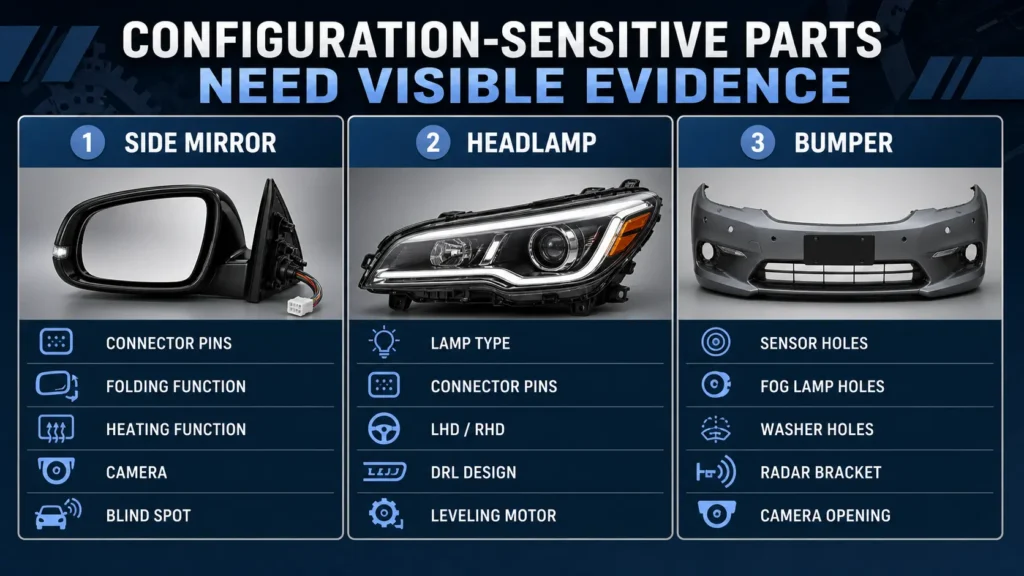
Side Mirrors
A side mirror looks simple in a product list.
In practice, it can carry many configuration differences.
A buyer may write “side mirror car,” “rear-view mirror,” or “driver side mirror replacement.” These terms are not enough for ordering.
Risk points:
manual folding or electric folding, heated or non-heated, turn signal, blind spot function, camera, memory function, puddle lamp, connector pins, and LHD/RHD market difference.
Photos to request:
full mirror photo, connector photo, wire harness photo, back-side label photo, and door mounting position photo.
Confirm before ordering:
side, drive market, folding function, heating function, camera function, blind spot function, plug type, and cover condition.
The outside shell may look right.
The function may still be wrong.
That is why car side mirror replacement by VIN and photo is more reliable than VIN alone.
For a driver side mirror replacement, side, market, and function must stay together. For a passenger side mirror replacement, connector photos can prevent a wrong option from entering the order.
For aftermarket auto mirrors, the plug often matters as much as the shell.
Headlamps
A headlamp is not just a lamp.
In sourcing, “headlight for car” is a starting phrase. It is not a complete specification.
A combination headlamp may be halogen, LED, xenon, or market-specific. It may have a leveling motor. It may use a different connector pinout. It may carry a different DRL layout. It may also differ between LHD and RHD markets.
Risk points:
halogen or LED, LHD/RHD beam pattern, leveling motor, DRL design, connector pinout, market version, and trim level.
Photos to request:
front lamp photo, rear lamp photo, connector photo, label photo, and vehicle front photo.
Confirm before ordering:
lamp type, drive market, plug layout, motor function, OE label, and vehicle front configuration.
Two headlamps can look similar from the front.
That does not mean they are the same part.
For aftermarket car headlights, the quote should not stop at name and price. It should confirm lamp type, connector pinout, and drive market.
A headlight for car with VIN and LHD RHD check may take longer to confirm. However, it can stop a wrong lamp before it reaches the workshop.
Bumpers and Front-End Parts
Bumpers create another type of risk.
The catalog picture may look correct.
The actual vehicle may need parking sensor holes, fog lamp holes, washer holes, radar brackets, camera openings, or a different grille structure.
This is common on vehicles with several trim levels.
Risk points:
sensor holes, fog lamp holes, washer holes, radar bracket, camera hole, grille version, upper/lower bumper section, and sport or standard trim.
Photos to request:
full front or rear vehicle photo, old bumper photo, sensor hole photo, fog lamp area photo, camera or radar area photo, and grille opening photo.
Confirm before ordering:
front or rear position, trim version, hole layout, radar or camera requirement, grille match, and upper/lower section.
A bumper without the correct holes is not a small error.
It can stop installation, delay repair, and create a claim that costs more than the part margin.
For car bumpers with sensor hole confirmation, photos are not optional. For bumper replacement with VIN and hole photos, visible vehicle details protect both buyer and supplier.
For aftermarket auto bumpers, radar bracket and camera position should not be assumed from the model name.
Other Configuration-Sensitive Parts
The same logic applies to switch panels, tail lamps, interior trims, grille trims, radar brackets, and camera-related front-end parts.
The more functions a part carries, the less useful a generic part name becomes.
A switch panel may differ by button layout.
A tail lamp may differ by market version.
A grille trim may differ by camera or radar position.
An interior trim may differ by color, texture, or function cutout.
For these parts, VIN is useful.
But photos often finish the job.
Why Large Orders Amplify Configuration Mistakes
Small orders sometimes survive weak information.
If a buyer asks for one mirror, one headlamp, or one bumper, a careful salesperson may slow down. They may ask for photos. They may notice that the EPC shows two options.
The order is small, so one person may inspect it closely.
However, large orders behave differently.
As a result, small configuration gaps can move through the process unnoticed.
A large Excel file may include dozens of SKUs.
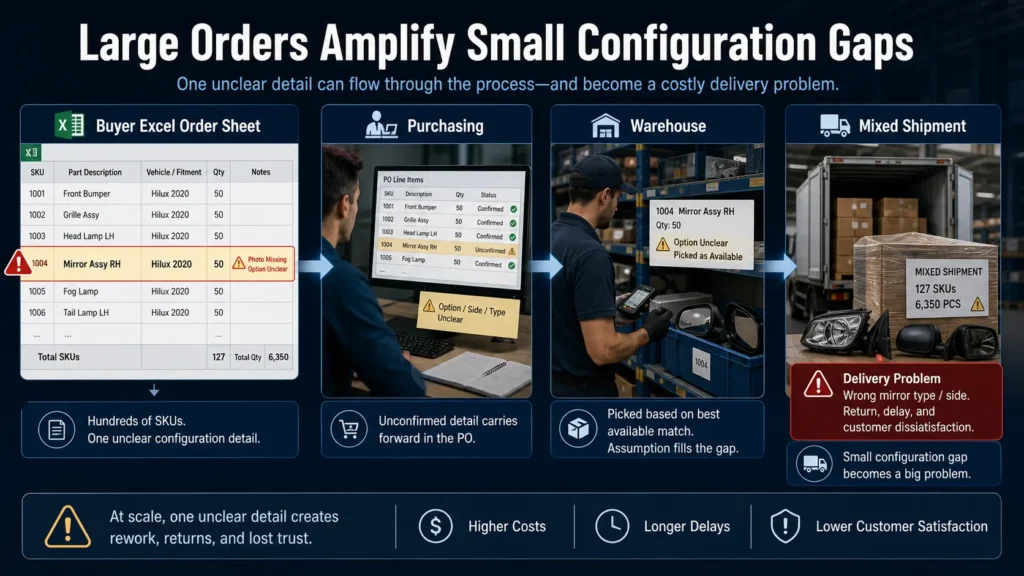
Some lines may have VINs. Some may only have part names. Some configuration-sensitive parts may have unclear descriptions.
Then the process becomes mechanical.
The sales team quotes by line.
The sourcing team buys by code.
The warehouse packs by label.
The buyer assumes the supplier checked everything.
The supplier assumes the buyer gave enough information.
That is how configuration risk moves forward.
A large order is not automatically more professional.
A large order needs stronger control because every unclear line has more places to hide.
One wrong mirror in a sample order is a correction.
A batch of wrong mirrors in a mixed shipment is a claim.
One wrong headlamp creates a workshop delay.
Repeated wrong headlamps create a customer trust problem.
The cost is not only the part.
It includes local return handling, mechanic waiting time, warehouse confusion, repeated communication, and future hesitation from the buyer’s customer.
This is the hidden cost of weak car parts by VIN and connector photos.
Weak Signal vs Strong Signal
A weak procurement signal sounds efficient.
The buyer sends VIN and part name.
The supplier replies, “Checked by VIN.”
The quotation uses a generic product name.
The buyer sees a price and moves forward.
But nothing has been truly locked.
The mirror quote does not mention folding, heating, camera, blind spot, or connector.
The headlamp quote does not mention halogen, LED, LHD, RHD, or connector pinout.
The bumper quote does not mention sensor holes, fog lamp holes, washer holes, radar bracket, or grille version.
That is not control.
It is a smooth process with hidden risk.
A strong signal looks less smooth.
The supplier may say:
“EPC shows two versions.”
“Photo required before confirmation.”
“Please confirm connector pins.”
“Please send the removed part label.”
“Please confirm whether the bumper has sensor holes.”
“Please confirm LHD or RHD.”
“We will hold this item until configuration is clear.”
This type of reply may slow the quotation.
But it protects the order.
The key difference is simple.
A weak supplier gives one answer too early.
A strong supplier separates the possible answers before money moves.
This connects directly with Procurement Signals #3. That article explains why not every question is real control. A useful question must change fitment, stock, packing, quote boundaries, or order handling.
For configuration-sensitive parts, the best question is often simple:
“Can you send a photo?”
Shared Control Starts Before the RFQ Is Sent
Some buyers expect the supplier to solve everything from VIN.
For standard parts, that may be reasonable.
For configuration-sensitive parts, it is not enough.
In practice, the buyer often has access to evidence the supplier cannot see.
The buyer can see the vehicle.
The buyer can photograph the removed part.
The buyer can count connector pins.
The buyer can show holes, lamps, buttons, cameras, and radar positions.
The buyer can ask the workshop to photograph the old part label.
This information is not decoration.
It is part of the RFQ.
A careful supplier can reduce risk. But no supplier can fully protect an order when the vehicle’s visible configuration is missing from the request.
Professional buyers do not only ask suppliers to be careful.
They build RFQs that make mistakes harder.
For a side mirror, they send function and connector evidence.
For a headlamp, they send lamp type and plug evidence.
For a bumper, they send hole and trim evidence.
For a switch panel, they send button layout and original label evidence.
This does not make the order slower.
It prevents the wrong order from moving too fast.
That is the buyer’s side of car parts by VIN for aftermarket sourcing.
Checklist Before Ordering Car Parts by Vin
This checklist is especially useful when buyers order car parts by VIN but cannot confirm the exact OE from the old part.
Before ordering mirrors, headlamps, bumpers, grilles, trims, switch panels, or camera-related parts, buyers should prepare a short evidence set.
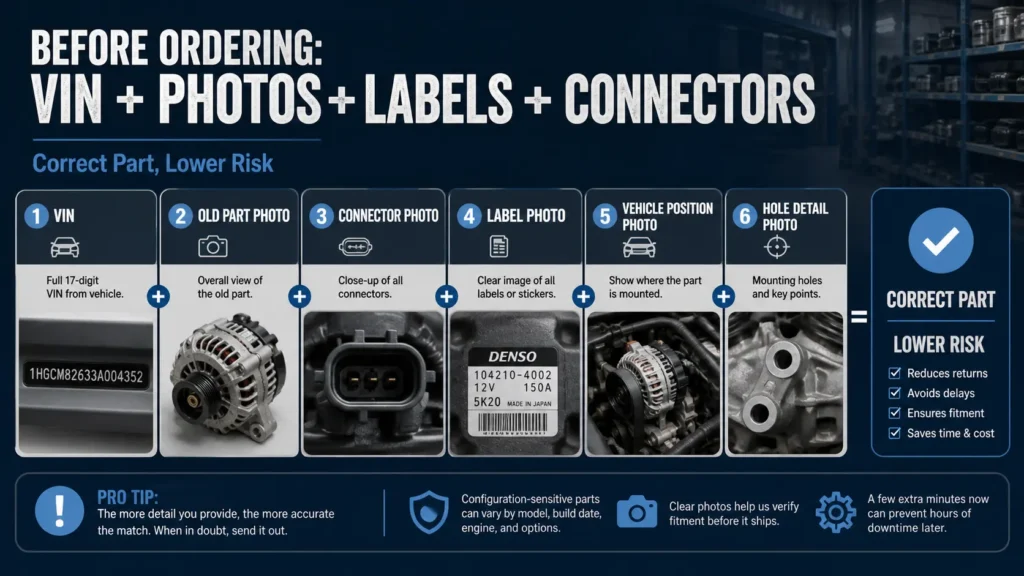
Minimum information:
VIN, vehicle model, market, year, LHD/RHD, part name, requested side, and position.
Photos:
removed part photo, connector photo, label photo, vehicle position photo, visible trim detail, and hole detail.
Configuration notes:
folding, heating, camera, blind spot, lamp type, sensor hole, radar bracket, washer hole, button layout, and trim version.
Order control notes:
mark unclear items as hold lines, separate possible versions, do not approve substitutes without photo comparison, and do not merge uncertain configuration parts into a bulk order without review.
This checklist is not only for the supplier.
It protects the buyer’s time, local warehouse, repair schedule, and customer relationship.
When the evidence is clear, the supplier can quote faster and with fewer assumptions.
When the evidence is weak, a fast answer is not a strong answer.
The Bilink Auto Parts View
Bilink Auto Parts does not treat VIN as the final answer.
We treat VIN as the first filter.
For side mirrors, combination headlamps, bumpers, grilles, trims, switch assemblies, and other configuration-sensitive auto parts, we prefer a complete evidence chain:
VIN + part name + old part photo + connector photo + label photo + visible vehicle configuration.
When EPC data shows several options, we do not pretend there is only one answer.
A photo conflict stops the process.
Unclear connector, hole, side, lamp type, or market version must be checked before the order moves forward.
This is not slow service.
It is low-cost risk control before a mistake becomes expensive.
In Procurement Signals #4, we explained why low price is often deferred risk. Configuration errors work the same way. A smooth quote may look efficient, but the real cost appears later through claims, delays, and customer hesitation.
In aftermarket auto parts sourcing, early friction is often the lowest-cost protection a buyer can get.
VIN opens the catalog. Photos close the risk.
More from the Procurement Signals Series
- Procurement Signals #1: The Sales Echo vs. Warehouse Reality
- Procurement Signals #2: Technical Curiosity Is Not Delay. It Is Control
- Procurement Signals #3: Not Every Question Is Control. Some Are Just Theater
- Procurement Signals #4: Low Price Is Not Control. It Is Often Deferred Risk
For an item-level review, send the VIN, reference numbers and photos of the existing parts, together with the required quantity and destination. Flag any configuration details that are still uncertain.