

In auto parts sourcing, buyers rarely lose money because a supplier looked weak. They lose money because a supplier looked strong in the wrong way. Growth, low price, scale, speed, catalog width, and OEM language can all create confidence quickly, but none of them automatically proves structural control.
These signals are not meaningless. They matter commercially.
The problem begins when buyers treat them as proof of structural control.
That is the core idea behind the Data Illusion Series.
Visible signals create confidence quickly. Structural reality reveals itself slowly. When importers confuse the two, supplier evaluation fails long before the parts do.
This series was written to help importers, distributors, and aftermarket buyers separate commercial appearance from operational reality. For buyers working in auto parts sourcing, that distinction becomes critical when visible supplier signals are treated as proof of real control.
Why Auto Parts Sourcing Fails When Visible Signals Mislead Buyers
Most supplier evaluations still start with the easiest metrics to see:
- sales growth
- quoted price
- factory scale
- delivery speed
- product range
- OEM-style positioning
These are useful starting points.
They do not, however, answer the questions that determine long-term sourcing success:
- Is the supply system stable under pressure?
- Is fitment control disciplined and accurate?
- Are packaging and labeling repeatable across batches?
- Can quality issues be traced and corrected at source?
- Does the supplier truly control the categories it sells?
A visible signal can support confidence.
It should never replace verification.
Illusion 1: Sales Growth vs Inventory Health
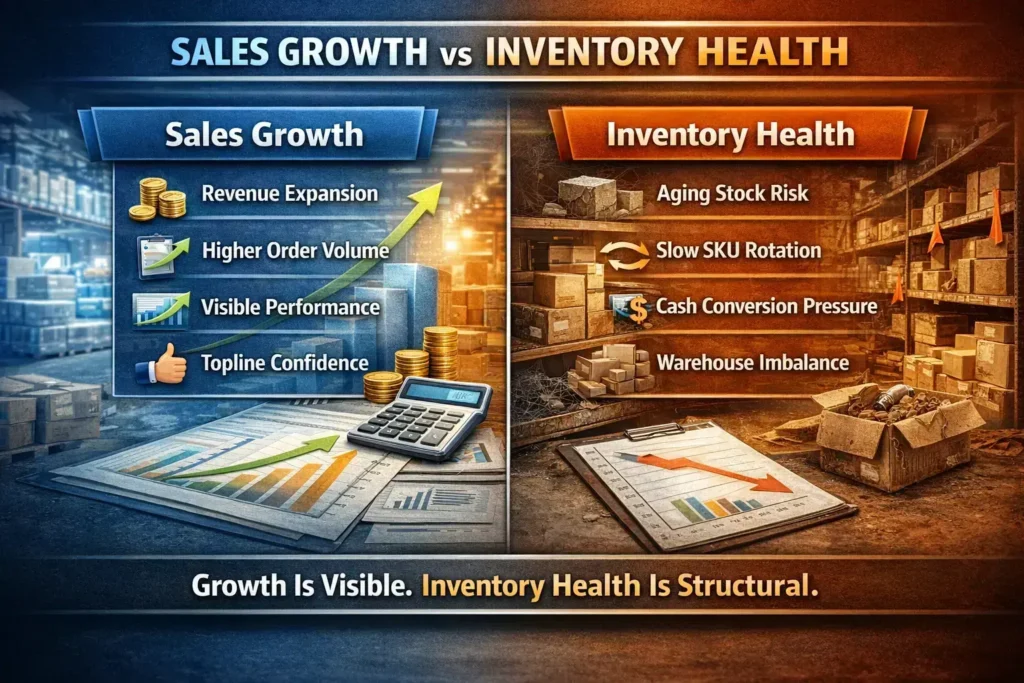
Rapid sales growth creates immediate confidence.
Importers often assume rising revenue signals a healthier operation. In reality, top-line growth can coexist with — or even mask — slower inventory turnover, aging stock, distorted SKU balance, and hidden warehouse drag.
Takeaway: Growth is a metric. Inventory health is a control problem.
Read Part 1 – Sales Growth vs Inventory Health
Illusion 2: Low Price vs Low Risk
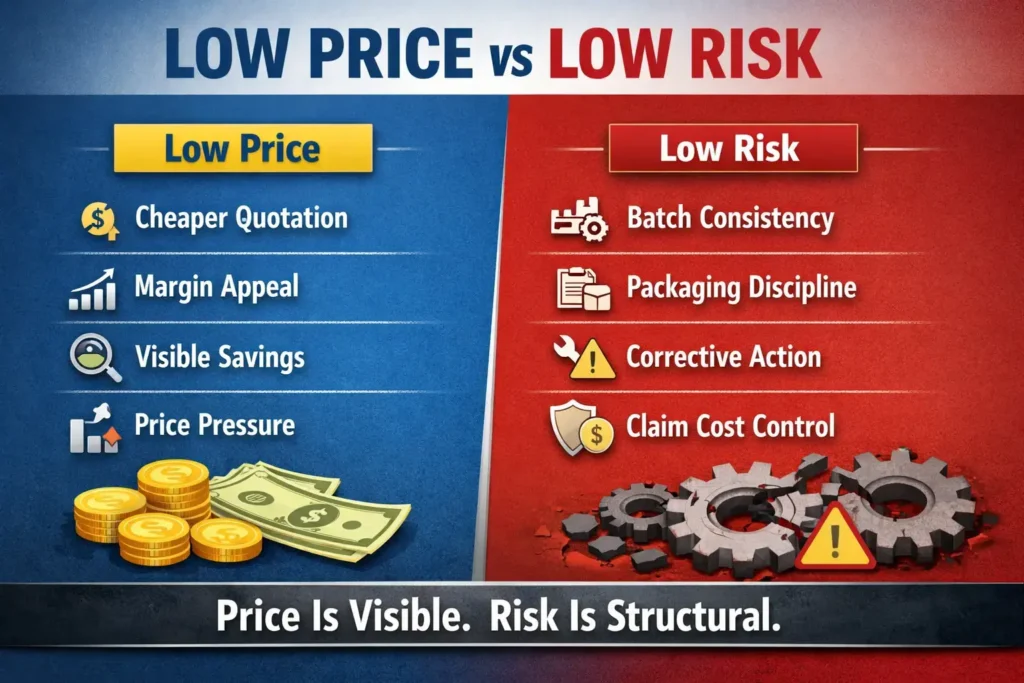
Low price remains one of the strongest magnets in aftermarket sourcing.
It feels objective and margin-friendly. Yet a cheaper quotation frequently conceals higher structural exposure: inconsistent batches, weaker packaging discipline, material variation, slower corrective action, and elevated downstream claim costs.
Takeaway: You are not only buying a part; you are buying the control quality behind the quotation.
Read Part 2 – Low Price vs Low Risk
Illusion 3: Big Supplier vs Stable Supplier
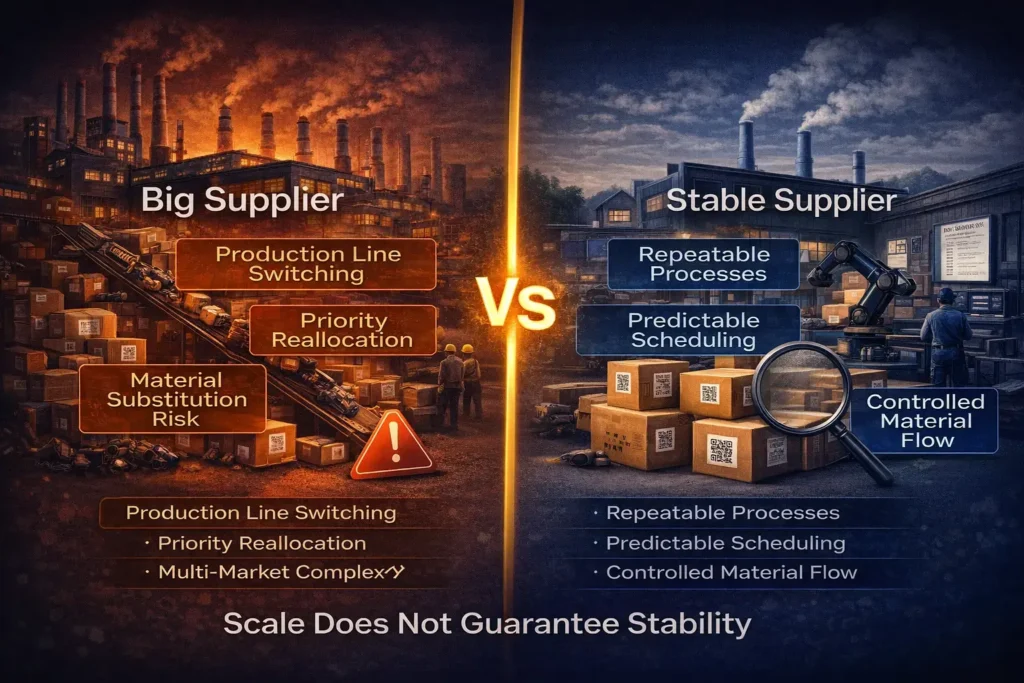
Large scale creates automatic trust.
Bigger factories, broader export reach, and higher capacity feel safer. However, scale measures complexity, not consistency. Larger operations often bring more production switching, internal prioritization, and uneven sub-supplier visibility.
Takeaway: Big means capable. Stable means predictable.
Read Part 3 – Big Supplier vs Stable Supplier
Illusion 4: Fast Delivery vs Supply Stability
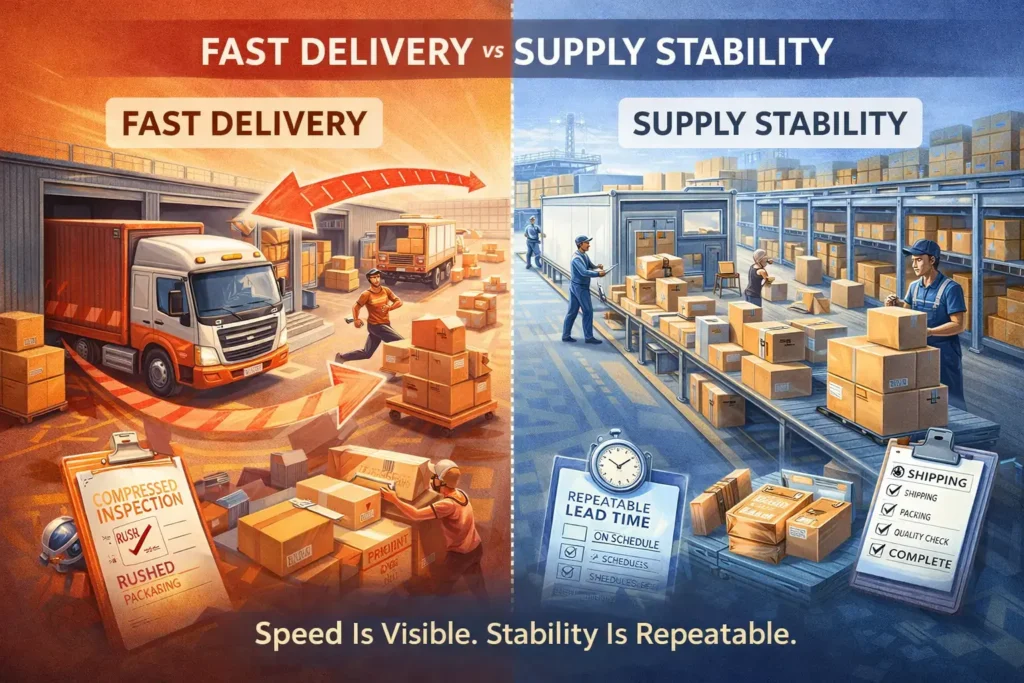
Fast shipment feels like proof of strength.
One early order can make a supplier look highly responsive. In practice, speed can result from temporary stock luck, compressed inspection, rushed packaging, or production priority shifts.
Takeaway: Short lead time is an event. Repeatable lead time is a system.
Read Part 4 – Fast Delivery vs Supply Stability
Illusion 5: Wide Product Range vs Supply Expertise
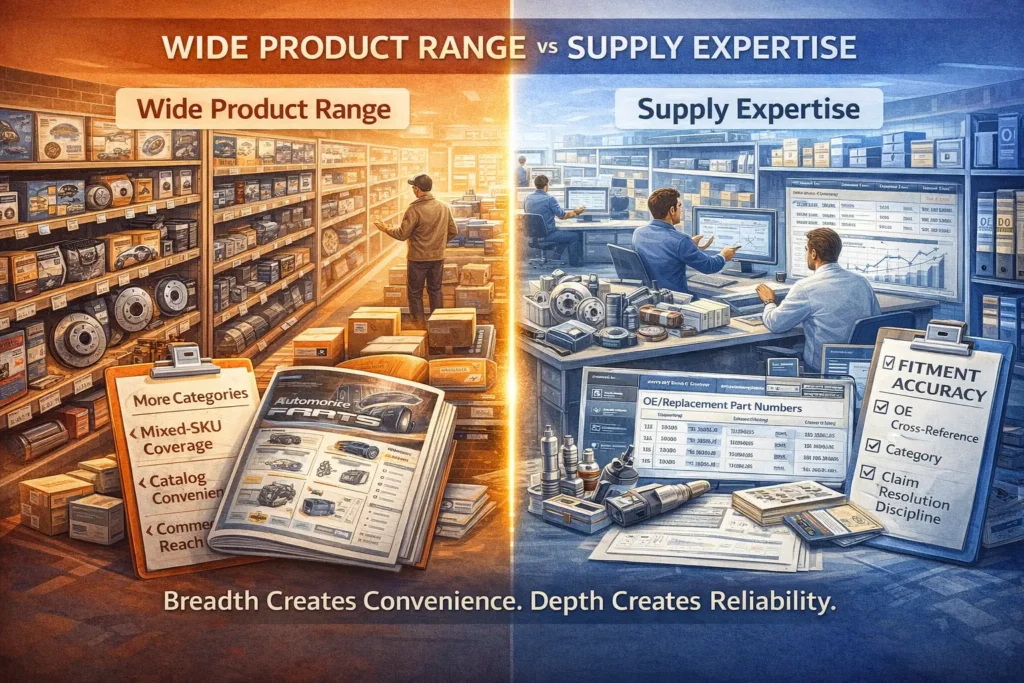
A broad catalog appears highly capable.
For importers managing mixed-SKU orders, wide coverage offers real commercial convenience. Yet catalog width is not the same as category depth. Fitment accuracy, packaging standards, and claim resolution quality often weaken when range expands faster than control systems.
Takeaway: Breadth creates convenience. Depth creates repeatable reliability.
Read Part 5 – Wide Product Range vs Supply Expertise
Illusion 6: OEM Label vs Real Manufacturing Control
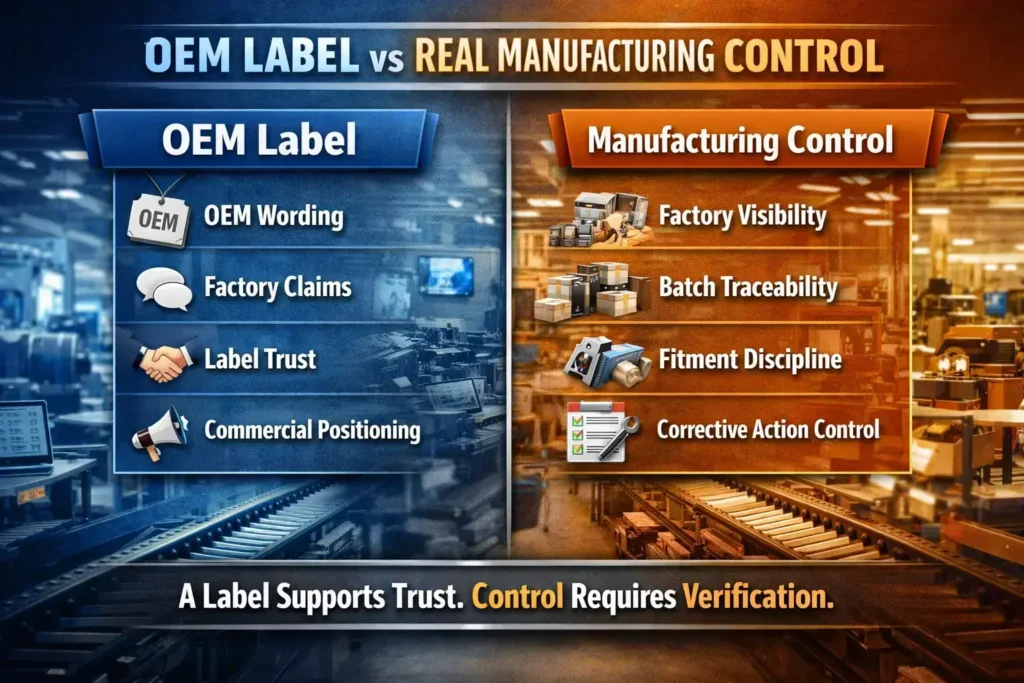
OEM language sounds more professional and trustworthy.
Buyers trust it quickly. In the aftermarket, however, label language is easy to adopt. Real manufacturing control — factory visibility, batch traceability, fitment discipline, and effective corrective action — is far harder to verify and maintain.
Takeaway: A label can support trust. Only traceable control can replace verification.
Read Part 6 – OEM Label vs Real Manufacturing Control
What These Six Illusions Share
Each illusion follows the same pattern:
A visible, easy-to-measure signal is mistaken for deeper structural proof.
- Growth mistaken for inventory health
- Low price mistaken for low risk
- Scale mistaken for stability
- Speed mistaken for continuity
- Breadth mistaken for expertise
- OEM language mistaken for manufacturing control
That is why many supplier relationships begin with confidence and later create friction, claims, or surprises.
The warning signs were not invisible — they were simply misread.
A Better Way to Evaluate Auto Parts Suppliers
Importers do not need to ignore visible signals.
They need to stop treating them as final evidence.
In auto parts sourcing, the strongest evaluation framework is the one that still works when attractive first signals begin to break down.
A stronger evaluation framework focuses on what remains controlled when pressure appears:
- inventory quality instead of topline growth
- batch traceability instead of price comfort
- operational consistency instead of factory size
- repeatable delivery instead of isolated speed
- category depth instead of catalog width
- verifiable manufacturing control instead of label language
The best question is not:
Which supplier looks strongest at first glance?
It is:
Which supplier can still demonstrate control when the visible signal is stripped away?
Conclusion
In auto parts sourcing, the biggest risk is rarely that a supplier looks obviously bad.
The bigger risk is that a supplier looks obviously good for reasons that are too easy to trust.
The Data Illusion Series exists to close that gap.
It is not about rejecting growth, price, scale, speed, breadth, or OEM language.
It is about refusing to mistake any of them for proof of real control.
Explore the Full Series
Related Insights for Further Evaluation
The Data Illusion Series: 6 Visible Signals That Hide Structural Risk in Auto Parts Sourcing
Data Illusion Series – Part 6: OEM Label vs Real Manufacturing Control in the OEM Auto Parts Market
Data Illusion Series – Part 5: Wide Product Range vs Supply Expertise for Automotive Aftermarket Parts Suppliers